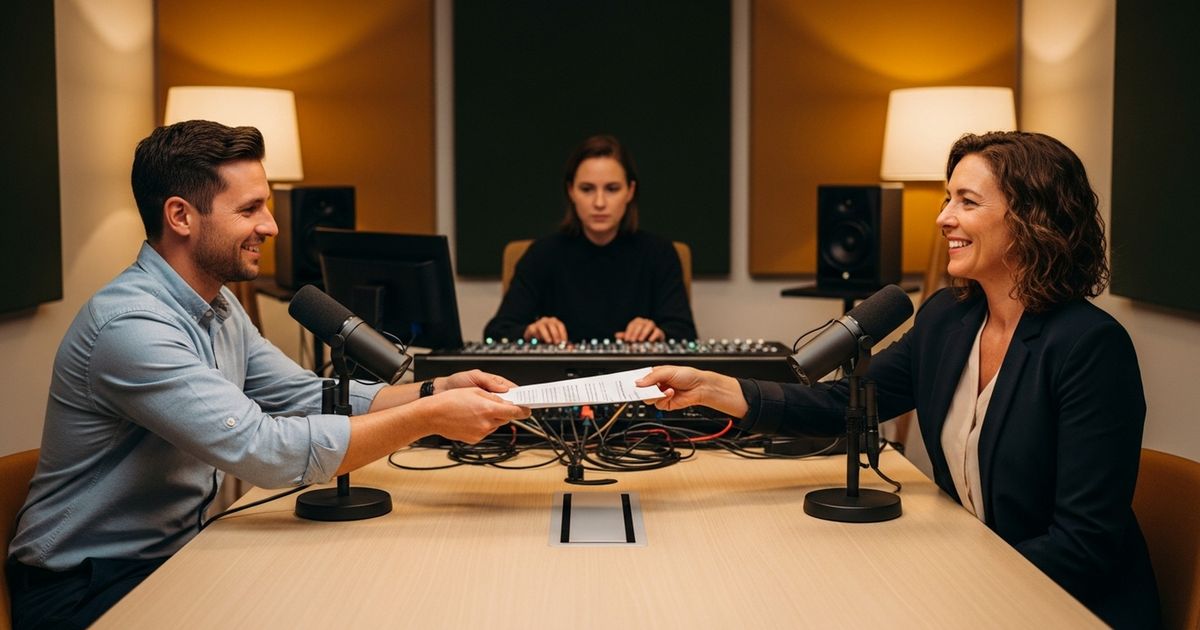
Podcast guesting and episode pages are underrated sources of high-quality backlinks. This guide shows exactly how to build links from podcasts: how to find the right shows, pitch so hosts will include show-note links, secure the correct anchor text and attributes, and turn every appearance into a content asset that moves organic metrics. Read on to get practical outreach language, tracking setup, and post-episode workflows that marketers can run in-house or scale with tools.
TL;DR:
-
Aim for a measurable goal: earn 5 contextual show-note links in 90 days and track conversions with UTM-tagged landing pages.
-
Pitch with a one-sheet and an exact URL; follow a 3-touch, 10–14 day cadence and offer a ready-to-paste show-note blurb.
-
After publish, repurpose the transcript into a keyword-optimized article, add internal links, and monitor referral traffic and assisted conversions.
Step 0: Prerequisites — What You Need Before You Try to Build Links From Podcasts
Before outreach, set targets and measurement so you know whether a podcast backlink produced value. Define goals that include links, referral traffic, and downstream conversions — not just domain rating. Example KPI: "Earn 5 contextual show-note links in 90 days and track assisted conversions from podcast referrals."
Technical Checklist
-
Set up UTM parameters for each outreach URL so GA4 can attribute sessions and conversions back to the episode.
-
Create a tracked landing page on your site (a clear offer or resource) and mark the canonical URL as your site's preferred absolute URL.
-
Confirm CMS readiness: ability to publish episode posts, add excerpts, and accept structured metadata (publish date, transcript, show notes).
Assets to Prepare
-
Speaker one-sheet: short bio, headshot, topic list, and 2–3 suggested questions.
-
Backlink URL list: preferred landing page plus 1–2 alternates (deep content, cornerstone pages).
-
Pre-written show-note blurb and suggested anchor text examples (anchor vs full URL options).
Why these matter
-
Hosts often prefer short copy they can paste. Providing the exact text reduces friction and increases the chance of correct linking.
-
Tracking with UTMs and a distinct landing page isolates podcast traffic from other channels. That makes it possible to measure assisted conversions and long-term SEO impact.
-
For platform rules and publisher requirements, reference publishing guidelines such as the Apple Podcasts content requirements, which include instructions on linking and premium content handling: Apple Podcasts content guidelines.
Decide who runs this
- Use the in-house vs agency checklist to decide whether your team should handle outreach or tap an external partner.
For background on link fundamentals, see the comprehensive link guide for tactics that support podcast-driven link strategies.
Step 1: Find Podcast Opportunities That Are Likely to Link
Finding shows that consistently publish episode pages with resources is half the battle. Target podcasts with host websites or dedicated episode pages that list links and resources.
Criteria for High-value Podcast Link Targets
-
Episode pages that regularly include show notes and resource links.
-
Interview formats where hosts include a "Resources" or "Links" section.
-
Hosts who run solo websites or blogs — those are likelier to add contextual links.
-
Audience fit: your target buyer persona should listen to the show.
Where to Source Podcasts
-
Directories: Apple Podcasts and Spotify for Podcasters can show show metadata and links to host sites.
-
Search tools: Listen Notes is excellent for keyword-based discovery and shows whether episodes have shownotes.
-
Marketplaces and guest platforms: use guest platforms to find shows actively booking guests.
-
Manual search: look for podcasts with recent posts that include resource lists.
Prioritization Matrix
- Create a simple scoring matrix (1–10) across three axes: audience fit, episode page link likelihood, and host behavior (mentions links, shows past guest links). Use the planning tool to populate scores and prioritize outreach.
Scoring example
-
Audience fit: 8
-
Link likelihood: 7 (episode pages usually include links)
-
Host behavior: 9 (host frequently posts guest follow-ups)
-
Combined score: 24/30 — high priority.
Compare guest appearance vs. sponsorship
-
Guest appearance: often cheaper in time and can yield contextual show-note links with anchor text.
-
Sponsored ad: provides control and visibility but usually links to campaign landing pages and may be marked sponsored/nofollow.
-
For link acquisition, prioritize shows with organic guesting that publish resources rather than paid ads.
Collect proof
-
Gather examples of prior episodes with links to show hosts you intend to pitch. These examples are persuasive in outreach and reduce uncertainty about link likelihood.
-
Academic and institutional podcast guidelines recommend including transcripts and resource links; for instance, some university podcast guidelines require a transcript link on each episode page: podcast guidelines from a university.
Also consider content tactics: compare targeting a show that links out often to doing a skyscraper technique style outreach for content assets that match the podcast's audience.
Step 2: Pitch and Book Appearances or Partnerships That Ask for Show-note Links
Pitching requires clarity and a low-effort ask. Hosts are busy. A short, relevant pitch with a clear value proposition and the exact URL you want in the show notes increases the chance of a link.
Personalize outreach and what to include
-
Subject line: 6–8 words that show topical fit (e.g., "Guest idea: growth experiments for early-stage SaaS").
-
Body: 2–3 sentences explaining relevance + 1 sentence with suggested topics + one-line bio.
-
Attach or link to a one-sheet with headshot and 2–3 sample questions.
-
Include the exact URL you want in the show notes and a one-sentence reason why listeners will benefit.
Concrete outreach structure (short)
-
First line: why this episode fits their audience (specific episode or quote).
-
Next: 2–3 topic bullets the guest can discuss.
-
Close: "If this fits, I'd love 20–30 minutes; my one-sheet and 2 suggested resource links are here: [URL]."
Suggested follow-up cadence
-
Touch 1: initial email or LinkedIn message.
-
Touch 2: follow-up after 4–6 days with a fresh angle (recent article or episode).
-
Touch 3: final polite reminder after 7–10 days.
-
Aim for 3 touches over 10–14 days as a simple cadence that respects hosts' inboxes.
Channels to try
-
Email is usually best for detailed pitching.
-
LinkedIn can work for hosts who are active there.
-
Podcast contact forms are common but may take longer; use them as a first step then follow up via email when possible.
Alternative partnership formats
-
Host swaps (two shows exchange guests and links).
-
Mini-series co-productions where both parties publish episode pages and resource links.
-
Co-produced episodes where both organizations host the episode transcript on their sites for dual linking opportunities.
Pitch language: short template example
-
Subject: "Guest idea: [topic] for [podcast name]"
-
Open: "Hi [host], loved your episode on [topic]. I run [role], and I have a 20-min angle on [specific insight]."
-
Suggested link line: "If you include resources, could you link to [exact URL] in the show notes? Happy to draft a one-line blurb."
Follow digital PR principles when crafting pitches; see guidance on digital PR tactics for message framing and social proof that increases success.
Legal and ethical considerations
-
Disclose paid arrangements or sponsorships. Paid links should be documented and may require rel="sponsored" or rel="nofollow" attributes per host policies.
-
Avoid schemes that incentivize hosts to create unnatural link patterns; those fall into risky territory per search engine guidance.
Step 3: Secure Links During Recording and Immediately After
Ask at the right time with the right words. The best moment is during the pre-interview or recording prep, not when you assume the link already exists.
How to Request a Show-note Link Without Sounding Transactional
-
Preface the ask with listener benefit: "If you plan to include resources for listeners, could you link to our guide on [topic] at [exact URL]? It has timestamps and a short summary that'll help listeners follow up."
-
Offer copy: "I can paste a one-line show-note blurb and the preferred anchor text if that helps."
What Language to Give Hosts for Anchor Text and Landing Pages
- Provide two options: an anchor text suggestion and an exact full URL. Example:
- Anchor option: "Comprehensive guide to onboarding emails" linking to your landing page.
-
Full URL option: your-site… (use tracked UTM in the URL).
-
Ask whether they add rel attributes and be prepared to accept rel="nofollow" or rel="sponsored" for paid components. Even nofollow links drive referral traffic and brand signals.
Post-episode Checklist (confirm Link, Timestamps, Collect Episode URL)
- Immediately after recording, send the host:
- The show-note blurb (40–60 words) and exact preferred anchor text.
- A UTM-tagged URL for tracking.
-
Timestamp suggestions for where to link (e.g., "link at 00:15:25 for 'how to set up UA'").
-
After publication, verify the link location and attribute. If wrong, request a correction and offer the exact HTML snippet to paste.
What to Do If the Host Won't Add a Link
-
Offer alternatives: request a tweet with the link, a pinned comment on the episode page, or a link in the episode transcript.
-
If the host provides only a social post, capture the URL and use it as a short-term referral even if it's not a backlink on a page.
-
As an escalation, politely ask for a redirect from a previous episode page or a mention in the host's resource page.
Data and host behavior
- Industry reports show a mix in how hosts manage links; a recent link-building survey highlights that many podcasts include resources inconsistently. For link-building context and broader link stats, see the BuzzStream link report: 70 link building statistics (2025).
YouTube and video embeds
- If the episode is published on YouTube or hosted with a video version, request the YouTube URL and ask for the episode page to embed the YouTube player—embedding the video on your own episode post can create an additional content surface that earns links and engagement.
What to say in the moment (micro-phrases)
-
"If you publish a resource list, would you be open to linking to our guide at [URL] so listeners can follow along?"
-
"I can send a short blurb and the exact URL right after the session."
[YouTube placeholder: "how to ask podcast hosts for backlinks and show notes"]
Step 4: Amplify Podcast Links Into SEO Value and Content Assets
A show-note link is the start. Turn that referral into long-term organic value by republishing and connecting the episode to your site's content structure.
Repurpose Transcripts Into Blog Posts and Link Internally
- Clean the transcript and create a keyword-optimized article (summary + highlights + timestamps). Decide between:
- Full transcript publish: good for complete verbatim content but may be thin for SEO unless accompanied by an original intro and structure.
-
Summary + highlights: often better UX and easier to optimize for target keywords.
-
Convert the episode into a post and use anchor text that points to pillar pages.
Use Internal Linking and Pillar-cluster Structure
-
Add internal links from the episode post to relevant pillar pages. This passes contextual relevance and helps search engines understand topical clusters.
-
If you use an automated topic clustering tool, programmatically tag episode posts to the appropriate pillar and generate internal link suggestions. SEOTakeoff supports topic clusters and automated internal linking and can publish directly to WordPress or other CMS to scale this workflow.
Suggested workflow example
-
Episode published → collect link and transcript.
-
Clean transcript → generate article with a 150–300 word intro, key takeaways, and timestamps.
-
Add 2–4 internal links to pillar pages and related posts.
-
Publish to CMS and submit sitemap update or request indexing.
Optimize repurposed content for search
-
Use free tools and workflows for keyword selection when refining the episode post; see the guide to free keyword research.
-
Target featured snippets where possible: structure the repurposed article with clear question-and-answer sections and optimized headings per the optimize for featured snippets guidance.
-
Consider AI-assisted generation cautiously and follow best practices in AI SEO techniques to preserve quality and avoid duplication.
Cross-format publishing
-
Convert audio to video and upload clips to YouTube or social channels. For guidance on optimizing video repurposing, see SEO for videographers.
-
Publish episode summaries as blog posts for readers and search traffic; use SEO for bloggers for conversion-focused structure.
Track, Measure, and Report SEO Impact
-
Monitor referral traffic, assisted conversions, and changes in organic traffic to the landing page.
-
KPIs: referral sessions from episode pages, number of backlinks acquired, change in organic impressions for linked pages, and conversions attributed via UTMs.
-
Run weekly link checks and rank tracking for the targeted pages to spot early changes.
Mobile and conversion considerations
- Ensure episode pages and repurposed posts are mobile-optimized; mobile visitors from podcast apps are common. See mobile SEO tips to improve load times and conversion flow.
Complementary outreach
- Amplify podcast reach with HARO and other PR channels to attract follow-up backlinks. For tactics that pair well with podcast outreach, see the guide on HARO link tactics.
Common Mistakes and Troubleshooting When Building Links From Podcasts
Below are common errors and quick fixes so time spent guesting actually turns into measurable SEO outcomes.
- Mistake: Assuming every podcast will add a follow link
- Fix: Ask early, provide copy, and accept alternative forms (social posts, transcript links). Track what you receive and treat nofollow links as referral and brand signals.
- Mistake: Sending generic outreach
- Fix: Personalize the first sentence to a recent episode or host comment, include 1–2 specific episode topic ideas, and attach a one-sheet.
- Mistake: Not using UTMs or tracked landing pages
- Fix: Create a UTM scheme and unique landing page to measure conversions from the podcast. Add event tracking in GA4 for clicks, signups, and downloads.
- Mistake: Not confirming link attributes or exact placement
- Fix: Provide the exact anchor and full URL. After publish, verify location and request corrections politely with the HTML snippet.
- Mistake: Mass-publishing raw transcripts without editing
- Fix: Clean transcripts, add introductory context, and avoid duplicate content across pages. See programmatic SEO pitfalls for errors to avoid when auto-generating pages.
- Mistake: Failing to repurpose content
- Fix: Convert episode audio into a focused blog post with internal links and an optimized title. Use a workflow that moves from transcript to cleaned article to CMS publish.
- Mistake: Paying for links without disclosure or planning
- Fix: If paying for placement, document it, expect rel="sponsored" attributes, and treat the value as referral/brand exposure rather than pure SEO equity.
Troubleshooting Delayed or Incorrect Links
-
Track with weekly link checks and alerts. If a link is delayed, send a friendly reminder with the suggested blurb and offer to paste it for them.
-
If a link is added incorrectly, request an edit and provide the exact HTML. If the host is unresponsive, document the attempt and capture social amplification opportunities instead.
Policy risks
- Avoid link schemes or reciprocal link networks that may trigger manual penalties. Research and follow official guidance when unsure; university research and peer-reviewed reports discuss podcast publication best practices and content use: see the analysis on podcasting as research dissemination for context: Leveraging podcasts as academic resources.
If you automate publishing, read guidance on safety and quality in is auto-publishing safe before bulk-generating episode pages.
The Bottom Line
Podcast guesting can produce valuable podcast backlinks and referral traffic when you target the right shows, pitch with a clear ask, and convert each appearance into republished content linked into your site’s topic clusters. Start with measurable KPIs, provide hosts with exact copy, and follow a transcript-to-article workflow to extract long-term SEO value.
Video: How to Start a Video Podcast in 2025 - Step
For a visual walkthrough of these concepts, check out this helpful video:
Frequently Asked Questions
How long until a podcast link impacts SEO?
It typically takes weeks to months to see measurable SEO movement from a podcast link. Referral traffic will appear quickly in GA4 (often within 24–72 hours), but changes to organic rankings or domain signals can take multiple indexing cycles. Expect to see referral-driven conversions early and organic ranking improvements over 6–12 weeks, depending on the authority of the linking site and how you amplify the episode with repurposed content.
What if the host uses nofollow or sponsored attributes?
Nofollow or rel="sponsored" links still send referral traffic and brand signals, which have value beyond direct link equity. Track the referral conversions and engagement from these links; if the episode drives qualified traffic, treat it as a marketing win. For paid relationships, document them and expect the link attribute; do not attempt to cloak or hide paid placements.
Can I pay to get links from podcasts?
Yes, podcasts accept paid placements, but paid links should be disclosed and usually require rel="sponsored" or rel="nofollow". Treat paid placements as paid media rather than pure SEO. If the host promises a contextual editorial link in exchange for payment, ensure the arrangement is transparent and documented to avoid compliance issues.
Is guesting the best way to get links compared with other tactics?
Guesting is an effective channel but not necessarily the "best" in isolation. It combines brand exposure, content, and link opportunities. For targeted link acquisition, combine guesting with HARO outreach and digital PR campaigns to diversify sources; see how HARO complements podcast efforts in the guide on HARO link tactics. Consider cost, time, and expected link quality when choosing channels.