Short answer: the best AI SEO tool is the one that removes your actual bottleneck without hiding new work in fact-checking, approvals, or publishing. Use a research suite for market and backlink data, an optimization tool for improving drafts, and an execution platform when the problem is running the complete research-to-publish-to-refresh workflow.
Last verified: August 18, 2026. Prices and limits below come from each vendor's official pricing page and can change. This comparison is not pay-to-rank and is not presented as a hands-on test of every vendor. We separate verified vendor facts from our own first-party SEOTakeoff workflow evidence.
How we evaluated AI SEO tools
We included tools that cover a materially different part of the SEO operating system. Each product was evaluated on seven questions:
- Job: research, optimization, production, publishing, monitoring, or several of these?
- Best fit: solo operator, founder, content team, agency, e-commerce team, or enterprise?
- Workflow coverage: does the product stop at recommendations, or help complete the work?
- Output and evidence: can a reviewer see sources, structure, and the finished page?
- Human review: what facts and decisions still require an accountable person?
- Integrations: can the result reach the team's CMS and analytics workflow?
- Current cost: what is the lowest relevant paid plan, and what limit matters?
We did not award points for the number of AI features in a navigation menu. A useful tool must make a specific job easier while keeping factual ownership visible. Google's people-first guidance similarly asks whether content demonstrates first-hand expertise and gives readers a satisfying answer, rather than whether a particular production technology was used.
AI SEO tools compared
Swipe sideways to compare all columns →
| Tool | Best for | Primary workflow | Publishing/integrations | Verified starting point | Main limitation |
|---|---|---|---|---|---|
| SEOTakeoff | Founders and small teams needing repeatable execution | Opportunity discovery, clusters, sourced drafts, internal links, QA, publishing, GSC-led refresh | WordPress, Webflow, Ghost, HubSpot, Sanity, Notion, Shopify, Wix, and webhook workflows are shown on the product site | Three articles free; $9 first month, then $69/month | Not a replacement for custom technical development, digital PR, or an accountable product expert |
| Surfer | Writers and teams optimizing pages against search and AI visibility signals | Content scoring, optimization, audits, topical planning, and AI visibility tracking | Official pricing lists WordPress, Google Docs, Contentful, and Zapier integrations | Discovery €49/month billed yearly; Standard €99/month billed yearly | Optimization guidance still requires a brief, factual inputs, editorial judgment, and publishing ownership |
| Clearscope | Content teams that value a focused optimization and AI-visibility workspace | Topic exploration, drafts, page tracking, prompt tracking, and content recommendations | Unlimited sharing/export is included; evaluate the CMS handoff separately for your stack | Essentials $129/month with 20 monthly topic explorations and 20 monthly drafts | It is primarily a content intelligence/optimization layer, not a complete SEO delivery team |
| Frase | Small teams wanting research, writing, optimization, publishing, and decay monitoring together | Research, articles, audits, SEO/GEO scores, AI visibility, and Content Guard | Official pricing lists WordPress, Webflow, Sanity, Wix, and FraseCMS | Starter $49 month-to-month or $39/month billed yearly; 10 articles and 50 audit pages monthly | Monthly limits and autonomous publishing require deliberate review and governance |
| MarketMuse | Strategists prioritizing existing inventories, topic authority, and content briefs | Inventory analysis, personalized difficulty, topic modeling, briefs, and strategy documents | Exports research and documents; production and CMS delivery normally remain separate | Free plan offers 10 queries/month; paid pricing is quote-led on the public page | Strong planning intelligence does not itself provide an end-to-end publishing operation |
| Ahrefs | SEO professionals needing backlink, keyword, competitor, crawl, and rank data | Research, site audit, rank tracking, competitive analysis, and AI brand tracking | API, MCP, Looker Studio on higher tiers, and reporting features; it is not positioned as a CMS publishing system | Lite $129/month; one user, five projects, 750 tracked keywords, and five tracked AI prompts | Excellent data still needs a strategy, writer/editor, implementation owner, and publishing workflow |
| Semrush | Teams wanting a broad SEO and AI-search suite across multiple disciplines | Keyword/competitor research, site audit, tracking, backlinks, reporting, and AI visibility | App ecosystem, reporting, API on Advanced, and MCP access on Starter and above | SEO plan $139 month-to-month or $117.33/month billed annually | Broad capability can be more system than a small team needs, and execution ownership remains with the customer |
Important: starting price does not make plans directly equivalent. A research suite, an optimization editor, and a managed execution platform sell different units of value. Compare the cost of the complete workflow—including internal review and implementation—not just the subscription.
Official pricing and feature sources
- SEOTakeoff product, workflow, integrations, and pricing
- Surfer official pricing and plan limits
- Clearscope official pricing and plan limits
- Frase official pricing, publishing integrations, and limits
- MarketMuse official plans and workflow details
- Ahrefs official pricing and product limits
- Semrush official SEO and AI-search pricing
Choose the tool by the job you need done
Choose an SEO research suite when data is the constraint
Ahrefs and Semrush are strongest when the team needs large keyword, backlink, competitor, rank, and crawl datasets. They help decide where to work. Budget separately for content creation, technical implementation, outreach, and editorial approval.
Choose a content intelligence tool when draft quality and prioritization are the constraint
Surfer and Clearscope focus the writing and optimization loop. MarketMuse puts more emphasis on inventory and topic-level strategy. These are sensible choices when a team already has writers and a CMS process but needs better briefs, prioritization, or page-level guidance.
Choose a content operating system when handoffs are the constraint
Frase now covers a broad content loop, including publishing and decay monitoring. SEOTakeoff is designed around the small-team execution gap: turning site context and opportunities into reviewable, source-backed pages, publishing them to the CMS, and using Search Console signals to decide what comes next.
If you are deciding whether software is enough—or whether you need people to own strategy, technical work, and authority building—use our separate AI SEO tools vs. agencies vs. hybrid decision guide. That page owns the delivery-model decision; this page owns tool selection.
A first-party workflow and output example
We can directly document SEOTakeoff's workflow because it is our product. The system analyzes a site, organizes opportunities into clusters, creates source-backed drafts, applies quality checks, supports review, publishes to connected CMSs, and surfaces Search Console-led refresh opportunities. The screenshot below shows a completed article in the editor rather than a marketing-only mockup.
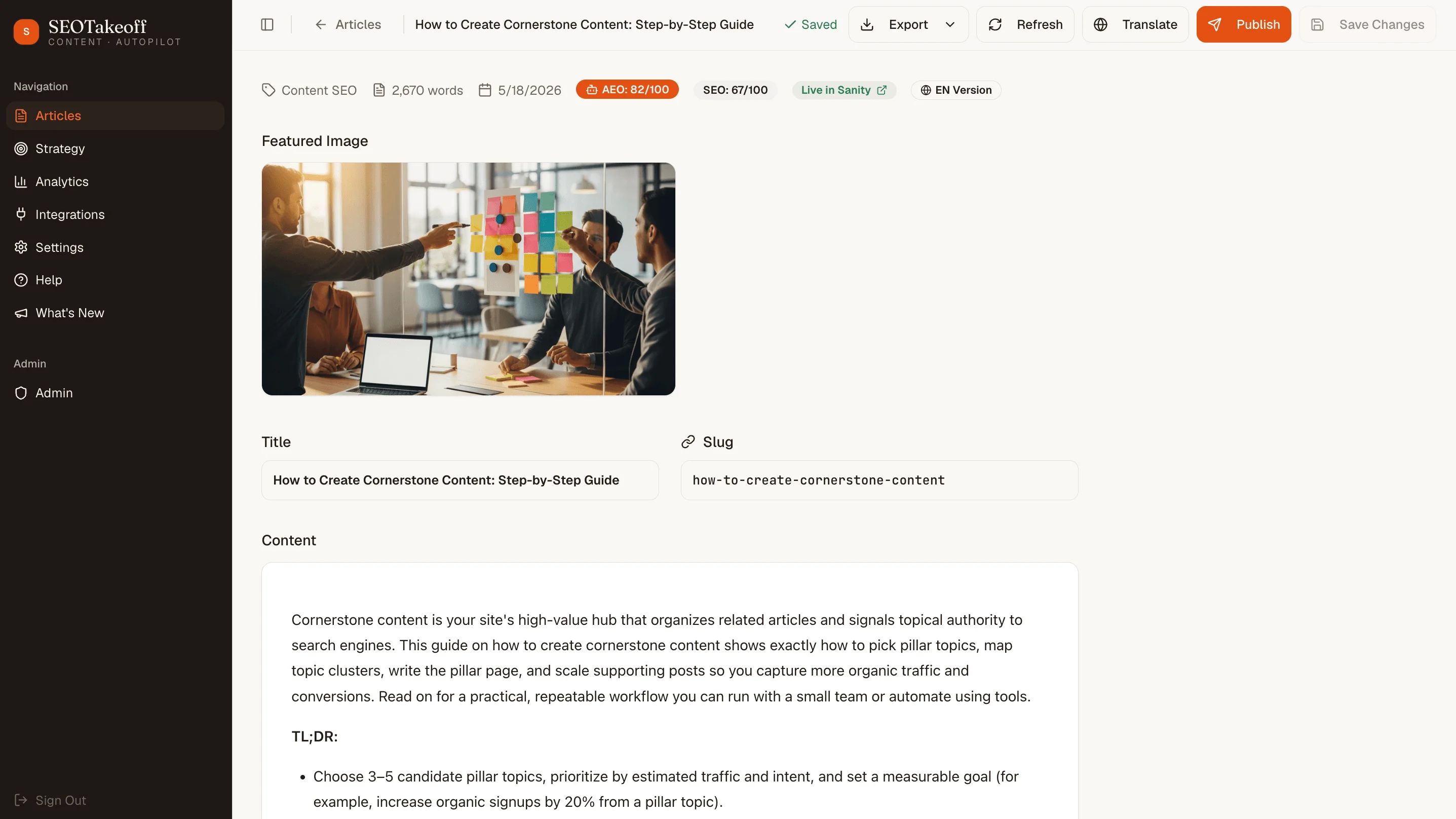
You can also inspect the output itself: an entity-researched city roundup, a software alternatives guide, and a customer-hosted production planning pillar guide. These examples prove that pages were produced and published; they do not guarantee a ranking outcome for another site.
The hidden variable: human review burden
Ask every vendor to show what a responsible reviewer must still do. At minimum:
- approve product, customer, legal, medical, or financial claims;
- verify volatile competitor prices and features;
- decide whether the topic helps a real buyer rather than merely matching a keyword;
- review generated images, links, schema, and calls to action;
- confirm that the correct canonical page reached the intended CMS; and
- measure indexation, clicks, qualified actions, and maintenance needs after launch.
A cheap subscription with four hours of cleanup per page is not cheaper than a more complete workflow. Conversely, a highly automated tool is a poor fit if nobody can supply expertise or approve sensitive facts.
Best fit by team
- Founder or very small team: choose a narrow execution system if consistency is the bottleneck; bring in a specialist for technical or strategic problems.
- Established content team: combine a research suite with the optimization or inventory tool that writers will actually use.
- Agency: prioritize multi-site governance, approvals, reporting, seat economics, exports, and clear client ownership.
- E-commerce: validate catalog scale, product/category workflows, structured data, Shopify or WooCommerce support, and bulk controls. See our AI SEO tools for e-commerce guide.
- Local business: do not buy a content tool expecting it to replace Google Business Profile management, reviews, citations, local links, or service-area accuracy.
Run a fair two-week pilot
- Use the same buyer question and the same source pack in each product.
- Record setup time, research time, editing time, publishing time, and defects—not just draft speed.
- Score factual accuracy, source quality, clarity, brand fit, internal links, metadata, schema, and CMS fidelity.
- Publish only after review, then track indexation and qualified engagement.
- Choose the product that reduces the complete cost of a useful live page.
For the wider operating-model decision, compare this guide with done-for-you SEO services and our SEO tool comparison hub.
Bottom line
There is no single AI SEO tool that is best for every team. Ahrefs and Semrush are data-rich suites; Surfer and Clearscope focus content optimization; MarketMuse emphasizes inventory and strategy; Frase spans a broad content loop; and SEOTakeoff focuses on repeatable small-team execution through publishing and measurement. Decide which work must disappear, verify the remaining human burden, and test the complete workflow with a real page before committing.
Editorial standard: Google's guidance on helpful, reliable, people-first content.