
Short answer: use an SEO agency when you need senior strategy, custom technical implementation, authority work, and someone accountable for coordination. Use an AI SEO tool when your strategy is reasonably clear but research, production, publishing, or maintenance capacity is the bottleneck. Use a hybrid when you need expert judgment for the hard decisions and software for the repeatable work.
Last substantially reviewed: August 18, 2026. This guide compares delivery models, not another ranked list of software. Costs are planning ranges, not quotes; ask every provider for scope, exclusions, ownership, and current terms.
Agency vs. AI SEO tool vs. freelancer vs. hybrid
Swipe sideways to compare all columns →
| Model | Best when | Strategy | Execution | Review burden | Main risk |
|---|---|---|---|---|---|
| SEO agency | The site or organization is complex and needs outside leadership | Usually included, but seniority varies | Can span technical, content, analytics, digital PR, and reporting | Client still supplies context, access, and approvals | Opaque staffing, slow context transfer, or deliverable volume replacing judgment |
| Freelancer/consultant | You have one defined constraint and an engaged internal owner | Strong when matched to the specialist's domain | Finite capacity; publishing and maintenance may remain internal | Moderate and usually direct | One person becomes a bottleneck or single point of failure |
| General AI assistant | You already own the brief, facts, editorial process, and publishing workflow | Prompt-dependent; it does not own prioritization | Fast help with bounded research, outlines, drafts, and revision | High: facts, links, structure, CMS, and measurement remain yours | A plausible draft is mistaken for a finished content operation |
| AI SEO execution platform | A small team needs a repeatable opportunity-to-publish loop | Structured recommendations and prioritization, with human business context | Research, production, QA, publishing, and monitoring can live in one workflow | Lower operational burden, but product facts and sensitive claims still need an owner | Automating weak inputs or publishing without governance |
| Hybrid | You need expert judgment and repeatable execution | Specialist/agency handles high-consequence decisions | Platform runs approved recurring work; internal expert supplies truth | Explicit approval gates by risk | Unclear ownership creates duplicate effort unless roles are written down |
Compare the models on seven factors
1. Cost structure
Do not compare a software subscription with an agency retainer as though they buy the same thing. An agency price may include specialists, meetings, custom implementation, reporting, and relationship work. Software may reduce research, production, and publishing labor but still requires an accountable reviewer. Compare the total monthly cost of strategy, production, implementation, review, and maintenance.
For a current software reference, our AI SEO tools comparison records official plan prices and limits. For service scoping, use the model-by-model checklist in done-for-you SEO services.
2. Time to value
A tool can produce a first draft quickly, but that is not the same as a useful live page. Measure time to an approved brief, reviewed content, correct CMS publication, indexation, and the first qualified action. Agencies may have a slower onboarding period but can solve broader strategic or technical constraints; software can be faster when the operating model is already clear.
3. Internal review burden
Every model needs client input. Agencies require access, business context, and approvals. Freelancers require a clear scope and decision maker. General AI assistants require the heaviest workflow ownership. Execution platforms can reduce handoffs, but a named human must still approve product claims, customer examples, regulated topics, and significant site changes.
4. Strategy and prioritization
Senior agency or consultant value is highest when the difficult question is what should we do? A platform is most valuable when the difficult question is how do we keep approved work moving every week? Ask any provider to show why it chose a page, what it deliberately excluded, and how it will change the plan when Search Console evidence contradicts the forecast.
5. Technical SEO and implementation
Complex migrations, international architecture, JavaScript rendering, faceted navigation, and enterprise governance usually justify specialist help. Content platforms should not imply they replace custom engineering. For ordinary publishing, insist on a demonstrated CMS path, correct canonical behavior, metadata, schema, internal links, and a rollback process.
6. Authority and link acquisition
Software can find prospects, organize outreach, and create link-worthy assets. It cannot manufacture genuine editorial trust. Agencies with credible digital PR or relationship-led authority capability may earn their fee here. Avoid providers promising guaranteed links or excessive reciprocal exchanges; Google's spam policies specifically call out manipulative link exchanges.
7. Reporting, learning, and ownership
You should retain ownership of the site, content, analytics accounts, Search Console property, source material, and performance history. Reports should distinguish outputs from outcomes: pages shipped, defects, indexation, impressions, clicks, qualified actions, conversions, and refresh decisions. A dashboard is not useful if the underlying definitions or access disappear when the contract ends.
What the execution-platform workflow looks like in practice
SEOTakeoff is our product, so this is first-party evidence rather than an independent review. Its workflow analyzes the site, groups opportunities into clusters, creates source-backed drafts, applies quality checks, supports human review, publishes to supported CMSs, and uses Search Console data to surface refresh opportunities.
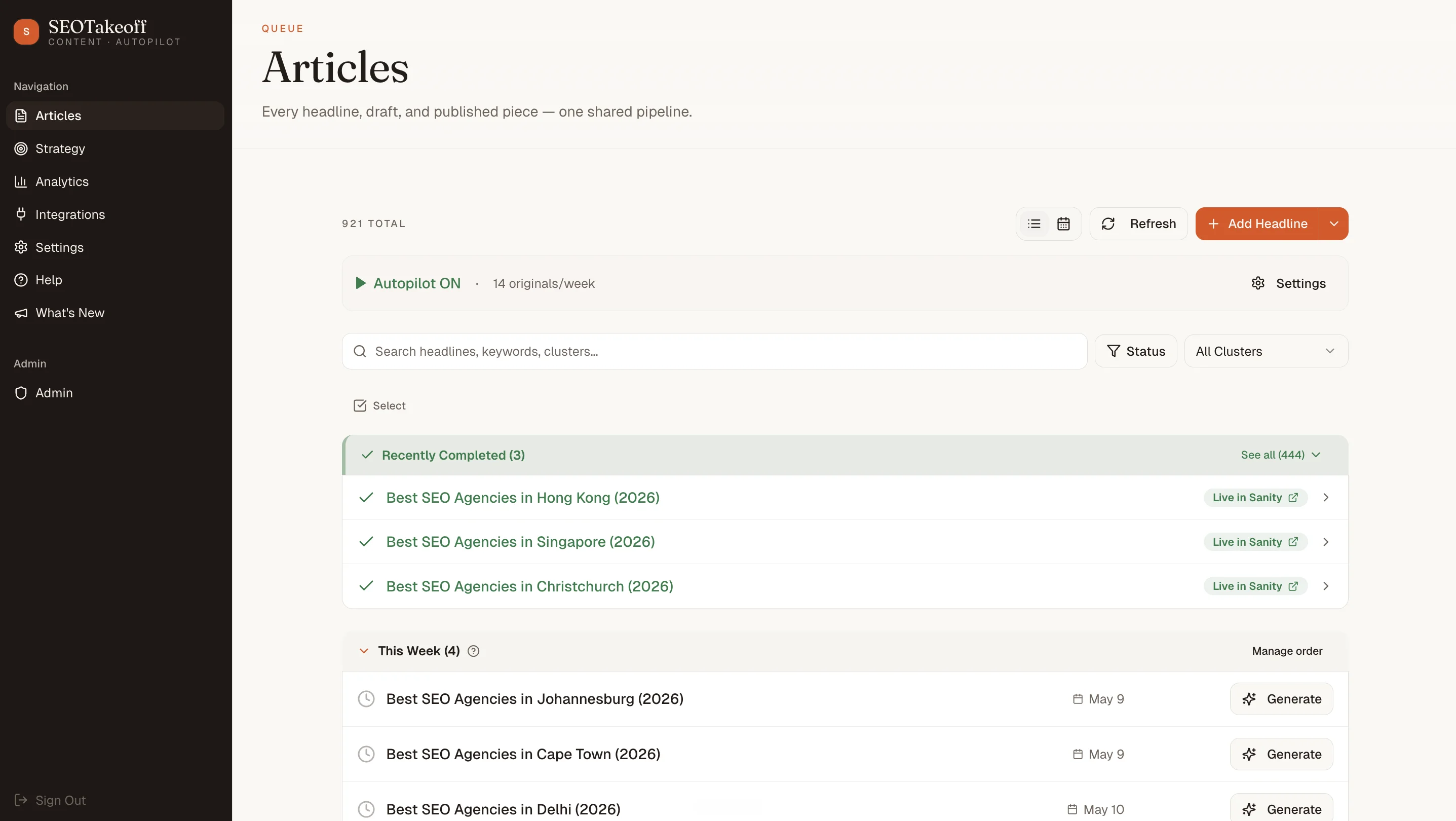
Inspecting live output is more useful than reading a feature promise. Examples include an entity-researched roundup, an alternatives comparison, and a customer-hosted B2B manufacturing guide. Results vary by site, market, baseline, authority, and publishing volume.
A 20-minute decision scorecard
- Name the bottleneck: strategy, technical implementation, expertise, production, publishing, authority, or maintenance.
- Name the accountable internal owner: who can approve facts, grant access, and decide what should not publish?
- Choose three pages: use real buyer decisions, not generic demonstration keywords.
- Write required capabilities: source checks, CMS, schema, review gates, analytics, refreshes, or digital PR.
- Calculate total cost: subscription/retainer plus internal review, implementation, and cleanup time.
- Run a time-boxed pilot: measure approved-page quality and time to publish, not raw draft volume.
- Preserve ownership: content, accounts, data, sources, and exportability must survive the relationship.
Best-fit verdicts
- Choose an agency for complex technical work, senior cross-functional strategy, digital PR, and external accountability.
- Choose a freelancer for a sharply scoped audit, strategy, technical problem, or editorial specialty with a strong internal owner.
- Choose ChatGPT or another general assistant for bounded tasks when your team already owns the full operating system.
- Choose an AI SEO execution platform when the recurring research, drafting, QA, publishing, and refresh loop is the constraint.
- Choose a hybrid when the strategy or technical risk needs expert judgment but repetitive execution should not consume expert hours.
How to measure a pilot
Swipe sideways to compare all columns →
| Stage | Measure | Failure signal |
|---|---|---|
| Setup | Days to approved priorities, access, and workflow | The provider cannot explain why the first pages matter |
| Production | Time to reviewed page, factual defects, source quality, internal edits | Draft speed rises while cleanup time is hidden |
| Publishing | CMS fidelity, metadata, schema, links, canonical, rollback | Copy-paste or developer queues recreate the bottleneck |
| Discovery | Indexation and impressions after recrawl | Pages remain excluded without a diagnosis |
| Outcome | Clicks, qualified actions, leads, assisted revenue, useful links | Reporting stops at article count or an unqualified traffic total |
| Maintenance | Refresh decisions, stale claims, link health, ownership | Nobody is accountable after publication |
Red flags in any model
- guaranteed rankings, traffic, AI citations, or backlinks;
- no named owner for factual review or technical changes;
- pricing without a written scope, limits, and exclusions;
- case studies that cannot be connected to the proposed work;
- content volume used as the primary outcome;
- no export or ownership terms for content and data;
- no explanation of what happens when a page does not index or perform; and
- automated publishing without risk-based approval controls.
Questions to answer before buying either model
A useful buying process starts with evidence from your own workflow. Pull the last three pages that stalled, underperformed, or consumed too much review time. For each one, identify whether the failure came from prioritization, missing expertise, technical implementation, production capacity, publishing, authority, or maintenance. That diagnosis is more useful than comparing feature counts.
- Who decides what not to publish? Ask for the approval rule for unsupported product claims, regulated advice, customer examples, and material site changes.
- Who owns implementation? A recommendation has little value if it waits indefinitely in a developer, editor, or CMS queue.
- What is inspected before launch? Require source checks, links, metadata, schema, canonical behavior, mobile rendering, and a rollback path.
- What happens after a page is live? The provider should define how it handles exclusion from the index, weak CTR, decaying claims, broken links, and pages that never earn useful demand.
- Can you export the work? Briefs, sources, content, analytics history, and decisions should remain available if you change providers.
For a small team with a clear strategy, a controlled platform often removes the most repetitive coordination. For a migration, international site, reputation-sensitive market, or unresolved positioning problem, senior specialist judgment is usually the scarcer resource. If both conditions are true, assign the specialist to decisions and exceptions while the platform handles approved recurring execution.
Bottom line
An AI SEO tool and an agency are not interchangeable. They remove different constraints. Buy an agency when expert judgment, implementation, authority, and accountability are the scarce resources. Buy software when the repeatable operating work is the scarce resource. Combine them when expert time is being spent on tasks a controlled workflow can handle.
Before choosing, compare the current AI SEO tool categories, official prices, and workflow limits, then use the managed SEO scope checklist to make every provider state what is included.
Editorial references: Google's people-first content guidance, Google's spam policies, and OpenAI's guidance on ChatGPT output limitations.