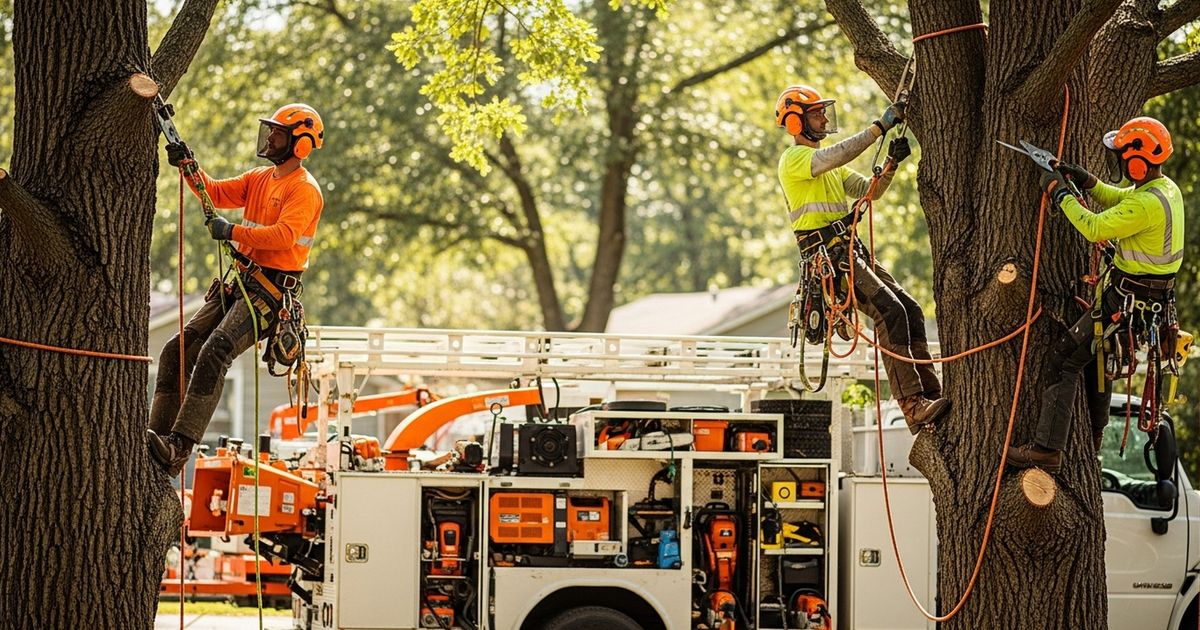
Tree services rely heavily on local search: homeowners and property managers look for fast, trusted providers when a limb hangs over a roof or a storm brings down a tree. Organic search and Google Business Profile (GBP) often deliver the highest-value leads for arborists — emergency jobs can be worth $500–$2,500, routine pruning $200–$800 — so a focused SEO approach pays off. This guide shows how to prioritize keywords, build service pages and pillar clusters, optimize GBP and technical SEO, earn local links, and scale content using automation.
TL;DR:
-
Prioritize GBP + 3–4 well-optimized service pages per primary town; expect measurable leads in 3–6 months with consistent GBP and content work.
-
Use a pillar-cluster taxonomy (pillar = "Tree services in [City]"; clusters = cost guides, emergency checklists, pruning how-tos) and aim for 4–8 target keywords per service page.
-
Fix technical basics (LCP <2.5s, mobile click-to-call, local schema), earn local .gov/.edu links, and scale content production with automation starting at $69/mo.
Why SEO Matters for Tree Services
Local search drives urgent and scheduled service bookings. Google Business Profile and the local pack appear prominently for queries like "tree removal near me" and "emergency tree removal [city]," and GBP often supplies direct calls or direction requests. Small-business studies and marketing guidance from the U.S. Small Business Administration show that local visibility and direct outreach increase conversion and referral opportunities for service firms: see the SBA's marketing guidance for small businesses.
Search behavior and seasonality
-
Emergency work spikes after storms; in many U.S. markets storm season and high-wind months (often August–October) produce large increases in "emergency tree removal" queries.
-
Scheduled work (pruning, planting) peaks in spring and late fall.
-
Mobile search share for local service queries often exceeds 50%, so mobile click-to-call must be front-and-center.
Lead value and prioritization
-
Typical one-off service values vary widely: small pruning jobs $200–$800; stump grinding $150–$1,000; major removals $500–$2,500 depending on size and access. Use job value to prioritize transactional keywords first.
-
For many tree services a single large removal can cover months of labor, so targeting high-intent, high-CPC keywords (as a proxy for commercial intent) is efficient.
Key local search tools and entities to use
-
Google Search Console and Google Business Profile for visibility and local-insights data.
-
Local chambers of commerce, municipal permitting pages, and industry groups (see ISA) to establish trust and links.
Key points
-
Focus on GBP and service pages for immediate lead capture.
-
Use seasonal content to capture spikes.
-
Track phone calls and form conversions tied to organic sessions.
Keyword Strategy: Targets and Taxonomy for Tree Services
Tree-service keyword strategy must group intent and geography. Start with a seed service (e.g., "tree removal") and expand into clusters: transactional, informational, and emergency queries.
Map Keywords by Intent: Informational, Transactional, Emergency
-
Transactional: "tree removal near me", "tree removal [city]", "stump grinding cost [city]". High commercial intent and high priority for service pages.
-
Emergency: "emergency tree removal [city]", "tree down after storm [zipcode]". Requires fast GBP/landing page and phone prominence.
-
Informational: "how to tell if a tree is diseased", "pruning best time", "stump grinding vs stump removal". Good for blog clusters and bringing in referrals.
Service-area Keywords and Modifiers
-
Primary pattern: [service] + [city] or "[service] near me" for mobile/local users.
-
Secondary modifiers: "cheap", "licensed", "insured", "24/7", and "same day".
-
Build location pages if you serve multiple towns; avoid thin duplicate pages — see the "programmatic vs manual" trade-offs below and consider quality-first location pages.
Long-tail and Seasonal Opportunity Keywords
-
Examples: "how much does stump grinding cost [city]" (low–medium volume, high intent), "when to prune oak trees [region]" (seasonal informational).
-
Use CPC as a proxy for commercial intent: higher CPC usually signals keywords that convert.
Sample keyword grouping (keyword / intent / page type)
-
"tree removal near me" / transactional / service page
-
"emergency tree removal [city]" / emergency / landing + GBP
-
"stump grinding cost" / transactional/informational / blog + service page
-
"how to tell if a tree is diseased" / informational / blog cluster
How many target keywords per service page
- Aim for 4–8 related target keywords per service page: primary transactional phrase, 2–3 location variants, and 1–2 long-tail modifiers for FAQ content.
Tools and automation
- Use AI-assisted discovery and clustering to expand from one seed topic into full clusters. For background on how AI helps keyword discovery and briefs, see our article on what is AI SEO.
On-Page SEO Checklist for Tree Services Websites
Service pages must convert visitors into calls or form fills. Follow a repeatable template and include local signals, schema, and trust elements.
Service page template essentials
-
Page title: include service + primary city (e.g., "Tree Removal in Springfield — Licensed Arborists").
-
H1: clear service and location.
-
Above-the-fold phone click-to-call button on mobile and a short lead form.
-
Brief scannable list of services offered and pricing ranges or starting prices.
-
Trust signals: licenses, insurance policy numbers, ISA-certified staff, customer testimonials, before/after photos.
-
Strong CTA: "Request a free estimate" or "Call for same-day service".
Local Business Schema and Structured Data
-
Use schema.org LocalBusiness or ProfessionalService with these properties: name, address, telephone, geo, openingHours, service offered, priceRange, sameAs (social links), and image. If your CMS uses plugins, ensure they output valid JSON-LD.
-
Example JSON-LD snippet:
<script type="application/ld+json">
{
  "@context": "https://schema.org",
  "@type": "LocalBusiness",
  "name": "Springfield Tree Co.",
  "address": {
    "@type": "PostalAddress",
    "streetAddress": "123 Oak St",
    "addressLocality": "Springfield",
    "addressRegion": "IL",
    "postalCode": "62701",
    "addressCountry": "US"
  },
  "geo": {
    "@type": "GeoCoordinates",
    "latitude": 39.7817,
    "longitude": -89.6501
  },
  "telephone": "+1-217-555-0123",
  "openingHours": "Mo-Fr 08:00-18:00",
  "priceRange": "$$$"
}
</script>
Meta Tags, Headings, and Content Length Guidance
-
Title/meta: include location and service; keep title under 60 characters when possible.
-
Headings: use H2s for subservices and H3s for FAQs.
-
Content length: 750–1,500 words for service pages; 1,200+ words for pillar pages. Include FAQs and local details to avoid thin pages.
-
Images: use photos showing crews, equipment, and permits when relevant. Compress images, use descriptive alt text (e.g., "crew removing large oak tree with crane"), and include captions when useful.
QA for AI-generated drafts
- If you use AI drafts, verify technical accuracy for safety and permitting topics. See our guidance on whether AI-generated content can rank.
Automation and publishing
- Use automated internal linking and CMS publishing to deploy service pages and keep link structures intact. SEOTakeoff supports automated topic clustering, internal linking, and direct CMS publishing to speed rollouts without a large writer team.
Local SEO & Google Business Profile Optimization
GBP is the primary lead generator for local tree services. Claim the profile, choose accurate categories, and use GBP features to make contacting and booking fast.
GBP Categories, Services, and Bookings
-
Primary category: choose the closest match (e.g., "Tree Service" or "Arborist"). Add relevant secondary categories sparingly.
-
Services section: list each service (tree removal, stump grinding, pruning) with short descriptions that include local modifiers.
-
Bookings: enable a booking link if you use scheduling software or offer estimates online.
Photo and post strategy
-
Upload clear before/after project photos and crew-on-site shots. Use photos to show safety and certifications.
-
Use GBP Posts for offers and emergency notices during storms. Track GBP Insights for calls, searches, and visibility.
Review Strategy and Reputation Management
- Ask for reviews after job completion; text messages with a short link work best. Use templates:
- "Thanks for choosing [Business]. If you have a moment, would you leave a short review about the work and crew?"
-
Reply to all reviews within 48 hours; for negative reviews, offer to continue offline and resolve.
-
Reviews influence local pack placement and CTR. A high volume of recent, local reviews improves trust.
Citations, NAP Consistency, and Local Signals
-
Run a citation audit to find inconsistent listings. Ensure Name, Address, Phone (NAP) match exactly across major directories.
-
Target local authority citations: municipal contracting pages, chamber pages, local news business listings.
Local resources and how-to
-
For official GBP setup steps, consult Google's guide to manage your Business Profile on Google.
-
For tactical local ranking factors, see Moz's local SEO guide.
Watch this step-by-step guide on run google local service ads:
Content Strategy: Pillars, Clusters, and Blog Topics for Tree Services
A pillar-cluster approach organizes topical authority and funnels searchers from informational queries to service pages and calls.
Building a pillar page and supporting clusters
-
Pillar page: "Tree Services in [City]" — explain scope of services, service area map, team credentials, and a strong conversion path.
-
Clusters: link from the pillar to cluster posts that answer specific customer questions (costs, safety, permits) and link back to service pages.
Top Blog Topics and Seasonal Calendar
-
Example cluster topics: "When to prune trees in [region]", "How to tell if a tree is diseased", "Stump grinding cost in [city]", "Emergency tree removal checklist".
-
12-month sample calendar:
- Spring: "Pruning guide for spring-flowering trees", "Planting new street trees"
- Summer: "Storm preparedness checklist for trees", "Signs of heat stress in trees"
- Fall: "When to schedule fall removals", "Preparing trees for winter"
- Winter: "Frozen tree hazard checklist", "Off-season maintenance tips"
Comparison/specs Table: Pillar Pages vs Service Pages vs Blog Posts
Swipe sideways to compare all columns →
| Page type | Purpose | Typical wordcount | Target keywords | Conversion CTA |
|---|---|---|---|---|
| Pillar page | City-level authority; links to services | 1,200–2,000 | Broad + location clusters | Request estimate / area map |
| Service page | Capture transactional intent | 750–1,500 | Service + city + variants | Call / book / get estimate |
| Blog post | Educate & capture long-tail traffic | 800–1,600 | How-to, cost, seasonal | Link to related service page |
Programmatic vs manual pages
-
Programmatic location pages can scale coverage quickly, but low-quality, thin pages harm rankings. See our discussion on programmatic vs manual for when to automate and when to handcraft pages.
-
SEOTakeoff's automated topic clustering can generate the content plan and drafts; teams should review safety and local permit details before publishing.
Sample cluster post titles and outlines
-
"Stump grinding cost in [City]" — cost breakdown, factors affecting price, local quotes, CTA.
-
"Emergency tree removal checklist" — safety steps, when to call pros, what to expect, insurance tips.
-
"How to identify a diseased tree" — signs, when to call an ISA-certified arborist, treatment options.
-
"Pruning schedule by tree species" — species list, seasonal timing, photos.
-
"Do I need a permit to remove a tree in [City]?" — link to municipal pages and permit steps.
For a practical publishing workflow that turns clusters into live pages, consult our guide to the publishing workflow.
Link Building and Local Partnerships for Tree Services
Local links increase authority and send referral traffic that converts. Prioritize relevance and trust over volume.
High-value Local Link Opportunities
-
Municipal pages (.gov) that list approved contractors or permit resources.
-
Local news outlets covering storm response or community projects.
-
Home improvement and landscaping blogs with project features.
Trade Organizations, Directories, and Sponsorships
-
Join and get listed by industry groups such as the International Society of Arboriculture (ISA) — see ISA resources at ISA education and credentialing.
-
Target local directories, chamber of commerce listings, and neighborhood association pages.
-
Sponsor a local event or playground tree-planting to earn local PR and links.
Content-led Link Tactics
- Create sharable assets:
- Storm preparedness checklist PDF for HOA distribution.
- Stump removal cost calculator page that local contractors and blogs can link to.
-
Project case studies with before/after photos, which local news may feature.
-
Outreach template idea:
- "Hi [Name], we created a storm-preparedness checklist tailored for [Town]. Would you be open to linking to it from your community resources page?"
Metrics for success
-
Prioritize links based on domain relevance and referral traffic rather than raw Domain Authority alone.
-
Track referral leads and conversion rates from local partner pages to measure ROI.
When rolling out multi-location link efforts, review programmatic approaches and quality controls in our piece about programmatic SEO explained.
Technical SEO and Site Structure for Service Businesses
Technical hygiene is a conversion multiplier: fast pages, clear URLs, and correct canonicalization make it easier for Google to index the pages that matter.
URL structure, canonicalization, and hreflang
-
Use flat, descriptive URLs: e.g., /services/tree-removal-springfield or /locations/springfield-tree-service.
-
Use canonical tags for near-duplicate pages (e.g., service pages that only vary by minor copy). For multi-region sites, implement hreflang only when you have content in different languages.
-
For CMSs, ensure sitemap.xml updates automatically and that server-side redirects handle deprecated pages.
Mobile Speed, Core Web Vitals, and Images
-
Targets: LCP <2.5s, FID or INP acceptable ranges per current guidelines, CLS <0.1.
-
Compress and serve images in modern formats (WebP/AVIF) and implement lazy loading for offscreen images.
-
If using WordPress, configure caching plugins and a CDN; if using site builders (Squarespace, Wix), evaluate speed trade-offs before publishing large image galleries.
Mini CMS publishing comparison (SEO implications)
Swipe sideways to compare all columns →
| CMS type | SEO pros | SEO cons |
|---|---|---|
| WordPress (self-hosted) | Plugin ecosystem (SEO, caching), sitemap control | Requires maintenance and plugin management |
| Page builders (Squarespace/Wix) | Fast setup, built-in hosting | Limited plugin control, potential speed issues at scale |
Internal linking and crawl budget
-
Prioritize a pillar -> cluster -> service linking pattern. Ensure main service pages are within three clicks of the homepage.
-
Use internal linking automation to surface new content across the site; SEOTakeoff supports automated internal linking to maintain coherent topical silos.
-
Monitor Google Search Console for crawl errors and indexation issues; fix soft 404s and redirect chains.
For technical best practices from Google on crawling and indexing, see the SEO Starter Guide.
Quick Action Checklist: SEO for Tree Services
A prioritized plan you can execute in 30/90/180 days.
-
Claim and verify Google Business Profile (1 day) — High impact: immediate visibility and calls. Track GBP insights.
-
Create or optimize 3 core service pages (3–7 days) — Medium/high impact: transactional keywords. Add schema and click-to-call.
-
Publish a city-level pillar page + 4 cluster posts (2–3 weeks) — Medium impact: builds topical authority.
-
Run a citation audit and correct NAP (2–3 days) — Medium impact: improves local consistency.
-
Set up tracking: GA4, Google Search Console, and call-tracking number (1–2 days) — High impact: measure leads and attribution.
-
Implement basic speed fixes (image compression, caching) (1 week) — Medium impact: improves conversions and Core Web Vitals.
-
Launch review solicitation workflow (ongoing) — High impact: reviews improve local pack rankings.
-
Reach out to 5 local partners for links (2 weeks) — Medium impact: referral traffic + authority.
-
Create 2 sharable assets (checklist PDF, cost calculator) (2–4 weeks) — Medium impact: linkable content.
-
Schedule monthly content publishing and internal linking (ongoing) — Long-term impact: organic growth.
Time estimates assume a small team or a contractor and can be accelerated with content automation tools.
Measuring ROI and Scaling Content Production with Automation
Track conversions and model revenue to justify SEO investment. Use measurable KPIs and a simple forecasting model.
KPIs to Track and Attribution Tips
-
Organic sessions, local pack impressions, GBP calls/direction requests, contact form submissions, conversion rate, and cost-per-lead.
-
Tie phone calls to landing pages with call tracking and use UTM parameters for paid vs organic campaigns.
-
Use Google Search Console to monitor keywords and impressions and GA4 for session and conversion analysis.
Simple revenue forecast model
-
Example: 1,000 organic sessions/month → 2% contact form conversion → 20 leads → average job value $800 → monthly revenue = 20 × $800 = $16,000.
-
Adjust lead-rate assumptions based on historical data (call-to-job close rate, quote-to-job conversion).
What to automate and what to review manually
-
Safe to automate: topic clustering, initial article drafts, metadata templates, internal linking, and CMS publishing for standard service pages.
-
Require human review: safety and permit content, photos and project case studies, local citation accuracy, and customer-facing pricing that affects liability.
SEOTakeoff features
-
Use SEOTakeoff for automated topic clustering, article generation, internal linking, and direct CMS publishing to scale content while keeping a review loop for sensitive items.
-
For guidance on effective automation tools, see our analysis of AI SEO tools and which approaches actually produce results.
Cadence for QA and audits
-
Weekly: GBP insights and response to new reviews.
-
Monthly: publish 2–4 cluster posts and check indexation.
-
Quarterly: full site audit and citation sweep.
The Bottom Line
Prioritize Google Business Profile and a small set of high-quality service pages, build a pillar-cluster content strategy to capture longer-tail and seasonal demand, fix technical basics, and pursue a few high-value local links. Small teams can scale output using automation tools to produce enterprise-level volumes without hiring large writer teams; SEOTakeoff plans start at $69/mo.
Frequently Asked Questions
How long does SEO for tree services take to produce measurable leads?
Expect initial leads from GBP and optimized service pages in 3–6 months for most markets. Content-driven authority (pillar + clusters) typically shows clearer organic traffic gains in 6–12 months. Timelines depend on competition, budget for link outreach, and seasonal demand in your area.
Should I focus on 'tree removal' or broader 'landscaping' keywords?
Prioritize specific tree-service keywords first (tree removal, stump grinding, pruning) because they match transactional intent and higher job value. Broader landscaping terms can be secondary clusters if you offer both services, but keep separate pages to avoid keyword cannibalization.
Can automated content rank for local service queries?
Automation can produce drafts and cluster plans that rank if human review ensures local accuracy, safety, and unique local details. Automate routine tasks (metadata, internal linking, drafts) and reserve manual review for legal, permit, and safety-sensitive content.
What schema types are most important for tree service pages?
Use schema.org LocalBusiness or ProfessionalService with address, telephone, geo, openingHours, priceRange, and service fields. Add Review and Image objects where relevant. Correct JSON-LD helps GBP and rich snippets.
How many location pages should a multi-area tree service have?
Create location pages only for areas you actively serve and can support with unique content (local projects, photos, testimonials). Avoid thin, boilerplate pages — quality matters more than quantity for local rankings and user trust.