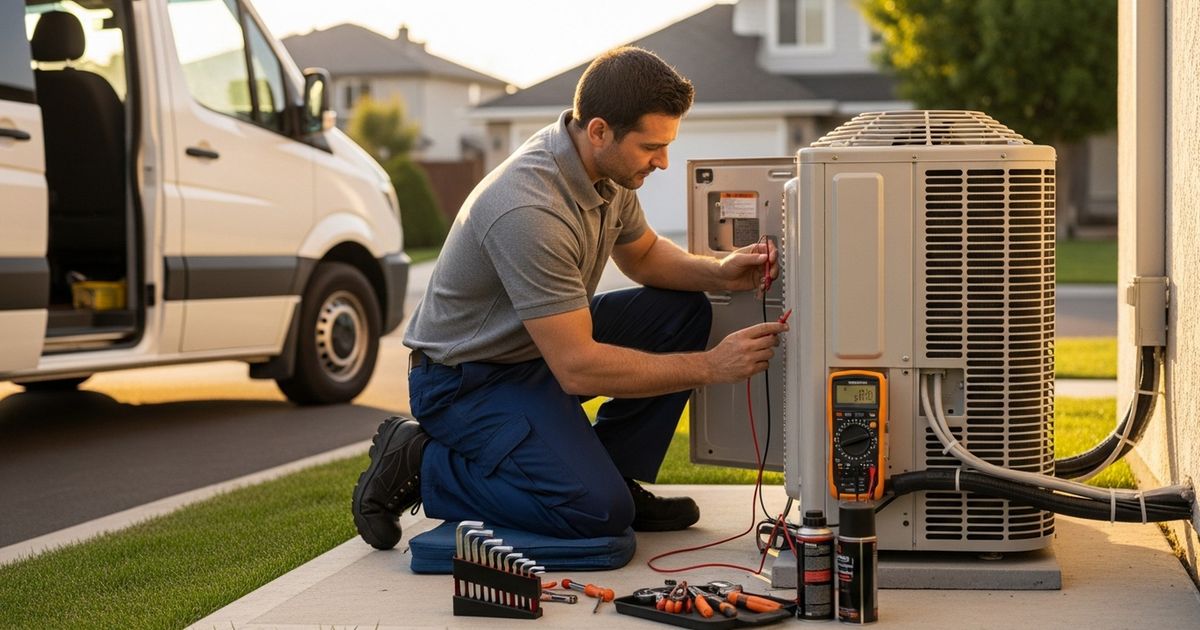
SEO for HVAC technicians focuses on turning local searchers into booked jobs and calls. This guide explains which queries send paying customers, how to build service pages that convert, and where to invest time versus automation so small teams can scale without breaking the bank. Read on for a practical checklist, templates you can copy, and a content workflow that ties keywords to revenue.
TL;DR:
-
Focus on local high-intent keywords (examples: "furnace repair near me tonight", "AC installation [city]") — these drive calls and booked jobs.
-
Fix Google Business Profile, NAP, and 3 technical items (mobile, speed, schema) for immediate lift; most take 1–7 days.
-
Use automated topic clustering and CMS publishing to produce 20–30 interlinked pages/month while keeping local facts and pricing human-reviewed — SEOTakeoff plans start at $69/mo.
How SEO for HVAC Technicians Works: Searcher Intent & Opportunity
HVAC searches split into clear intent buckets: emergency/transactional (repair now), commercial/installation (quote and estimate), and informational (how-tos, maintenance). Emergency queries like "furnace repair near me tonight" are high conversion; a well-optimized emergency landing page should capture those calls. Research shows that many local mobile searches lead to same-day actions — for example, Google research indicates a large share of local mobile queries result in store visits or calls within 24 hours, so speed and visibility are critical.
Map intent to page types:
-
Service pages: Targeted at commercial and transactional queries (e.g., "AC repair [city]"). These should include clear CTAs and phone numbers.
-
Emergency landing pages: Optimized for urgency modifiers (tonight, now, same-day) and mobile-first layout.
-
Blog/how-to content: Captures long-tail informational queries (e.g., "how to change furnace filter") and feeds internal links to service pages.
-
Pillar pages: Consolidate core service topics and link to clusters across locations.
Energy usage patterns affect demand. The Department of Energy publishes guidance showing seasonal peaks for cooling and heating; use those patterns to schedule campaigns and seasonal landing pages (Department of Energy's guide to energy efficiency). For business outcomes, measure calls, booked jobs, average job value, and conversion rate from organic landing pages to tie SEO to revenue.
Keyword Research for HVAC Technicians: Find the Money Keywords
Start with a seed list made from your actual services: AC repair, furnace repair, HVAC maintenance, duct cleaning, thermostat installation. Combine each service with location modifiers: city, neighborhood, and "near me" modifiers. Example seeds for a 3-city area (Springfield, Riverview, Lakewood):
-
"AC repair Springfield"
-
"emergency furnace repair Riverview"
-
"duct cleaning Lakewood price"
Sources for long-tail and seasonal keywords:
-
Search Console queries for existing site traffic
-
Local forums, Facebook groups, Nextdoor threads for neighborhood phrasing
-
Weather and seasonal spikes (monitor historical search volume)
-
Tools: Ahrefs, SEMrush, and BrightLocal for local volume and difficulty estimates
Prioritization matrix (simple): score each keyword on Intent (3 high to 1 low), Volume, and Difficulty. Multiply Intent × Volume / Difficulty to rank. Put emergency and high-intent local keywords at the top.
Use automation to expand and cluster seed lists — automated topic clustering can group hundreds of modifiers into service clusters, then generate briefs and internal link maps. For a 3-city example cluster for "AC repair":
-
Pillar: "Air conditioner repair and maintenance"
-
Cluster pages: "AC repair Springfield", "AC repair Riverview", "AC repair Lakewood", plus seasonal guides like "pre-season AC tune-up checklist".
For a deeper primer on AI-assisted keyword processes and what works, see what is AI SEO. For practical keyword research tactics, the Moz learning guides are a helpful reference (Moz local SEO and keyword research resources).
On-Page SEO & Content Templates for HVAC Technicians
Service pages should follow a predictable, conversion-focused structure. Use this high-converting template:
-
Title tag: [service] in [city] | [Brand] — example: "Air Conditioner Repair in Springfield | Northside HVAC"
-
H1: Air Conditioner Repair in Springfield
-
Intro: 1–2 sentences addressing urgency and phone CTA above the fold
-
Bulleted services: list common fixes and brands
-
Pricing transparency: estimated ranges or "starting at" price if acceptable
-
Reviews snippet: 2–3 local review quotes with star rating
-
FAQ schema: 3–6 questions about warranty, emergency fees, turnaround time
-
CTA block: Click-to-call, estimate form, scheduling link
Example title/meta:
-
Title: "Furnace Repair Riverview — Same-Day Service"
-
Meta description: "Same-day furnace repair in Riverview. Flat-rate diagnostics, certified technicians, and emergency visits. Call now for an on-site estimate."
Schema & Metadata Checklist:
-
Use LocalBusiness or HomeAndConstructionBusiness schema with Service and Review nested where applicable
-
Add structured data for FAQ and Service to increase rich result chances
-
Ensure meta titles include location and primary service
-
Include structured opening hours and accepted payment methods
For safety and credibility, reference industry standards when writing technical or safety content — OSHA guidance for technician safety and ACCA best practices for installation norms add trust (OSHA workplace safety guidance for HVAC and field technicians, Air Conditioning Contractors of America industry best practices). Link your site audit tool to catch missing metadata and schema: SEOTakeoff's site audit flags absent title tags, missing structured data, and duplicate meta descriptions.
Internal linking pattern: every blog how-to should link to 2–3 related local service pages. Example content brief:
-
Target KW: "AC tune-up checklist [city]"
-
Word count: 800–1,200 words
-
LSI topics: seasonal maintenance, filter replacement, energy savings
-
CTA: "Schedule your pre-summer tune-up" with click-to-call and booking link
-
Suggested internal links: "AC repair [city]" service page, financing options page
Local SEO for HVAC Technicians: Google Business & Reviews
Google Business Profile (GBP) is often the top driver of local calls. Claim and verify your GBP, then optimize these fields:
-
Primary category: pick the most specific service that matches your core offer
-
Service area: set to the cities/neighborhoods you serve (do not use a storefront address for service-area businesses unless you accept customers at that location)
-
Hours: include emergency hours and holiday exceptions
-
Booking links: connect online scheduling if available
-
Photos: add service photos (no logos), team photos, and before/after shots
For official GBP setup and limits, consult Google's help center (Google business profile help center). Businesses often see a measurable lift from recent reviews; Google highlights review recency and rating. Best practices for review acquisition:
-
Ask for reviews after completed jobs via SMS or email with a direct review link
-
Display curated reviews on your site with Review schema
-
Respond to negative reviews professionally and promptly
Citations and NAP consistency: Monitor listing accuracy across major directories (Yelp, Angi, local chambers). SEOTakeoff's site audit can surface NAP mismatches and on-site inconsistencies so you can fix them quickly. Data shows that accurate local signals and reviews correlate with higher local pack rankings, so prioritize fixing NAP errors first.
Technical SEO for HVAC Websites: Speed, Crawlability, and Structure
Essential Technical Checklist (prioritized):
-
Mobile-first: pages must be responsive and use a fast mobile layout
-
Speed: aim for Core Web Vitals targets (see table below)
-
SSL: HTTPS across the site
-
XML sitemap and robots.txt: submit sitemap to Search Console
-
Redirects and canonical tags: handle old location pages and duplicate content
-
Structured data: implement LocalBusiness, Service, and Review schema
-
Crawl budget: keep low-value thin pages out of index via noindex or robots rules
Comparison/specs table for speed targets:
Swipe sideways to compare all columns →
| Metric | Desktop target | Mobile target | Recommended image formats |
|---|---|---|---|
| Largest Contentful Paint (LCP) | < 2.5s | < 2.5s | WebP or AVIF |
| First Input Delay (FID) / Interaction | < 100 ms | < 100 ms | Use responsive srcset |
| Cumulative Layout Shift (CLS) | < 0.1 | < 0.1 | Set explicit image dimensions |
Use Google Search Central guides for structured data, crawling, and Core Web Vitals recommendations (Google Search Central — structured data and technical SEO docs). Image formats like WebP reduce payload; lazy-load non-critical images, but keep hero images eager for user experience.
URL Structure and Pillar-cluster Organization:
-
Use readable URLs: /services/ac-repair-springfield
-
Pillar page example: /services/air-conditioning — links to city-specific pages (/services/ac-repair-springfield, /services/ac-repair-riverview)
-
Avoid creating near-duplicate pages for minor variations; instead, canonicalize or consolidate
SEOTakeoff's internal linking automation helps implement these pillar-cluster links at scale, ensuring every new cluster has the correct inbound links and anchor text.
Key SEO Quick Wins for HVAC Technicians
-
Claim Google Business Profile — Time: 1–3 days. Impact: High. How-to: Verify and set service area, hours, and booking link.
-
Fix NAP inconsistencies on top 10 directories — Time: 1–7 days. Impact: High. How-to: Use a citation tool or manual checks; update phone and address.
-
Publish 3 service pages with location modifiers — Time: 1–2 weeks. Impact: High. How-to: Use the service page template above and include click-to-call.
-
Add FAQ schema to service pages — Time: 1 day. Impact: Medium. How-to: Add 3–6 questions about pricing, response times, and warranties.
-
Remove duplicate pages or merge thin content — Time: 2–7 days. Impact: Medium. How-to: Use site audit to find duplicates; 301 to consolidated page.
-
Speed up top landing pages (LCP under 2.5s) — Time: 1–3 weeks. Impact: High. How-to: Compress images, use CDNs, audit third-party scripts.
-
Ask for 5 recent reviews per location — Time: ongoing. Impact: High. How-to: Send post-job SMS with direct review link.
-
Create seasonal landing pages (pre-summer AC tune-up, pre-winter furnace check) — Time: 1–2 weeks. Impact: Medium. How-to: Target seasonal queries and promote on GBP.
These are actions a technician or small team can implement in days to weeks and often produce measurable improvements in calls and leads.
Scaling Content & Internal Linking: Use Automation without Losing Quality
Automation helps with repeatable tasks: keyword expansion, cluster generation, first drafts, and building internal link maps. Human review is still essential for local facts, pricing, and safety statements.
What to Automate (and What to Keep Human):
-
Automate: seed expansion, topic clustering, draft outlines, internal link creation, bulk publishing to CMS
-
Keep human: local references (neighborhood names), exact pricing or financing offers, technician credentials, and review moderation
Comparison Table: Manual vs Automated Content Production
Swipe sideways to compare all columns →
| Factor | Manual (freelancers + in-house) | Automated platform |
|---|---|---|
| Monthly output | 4–12 articles | 30+ articles |
| Typical cost/month | $3,000–$8,000 | Lower fixed subscription (starts at $69/mo) |
| Time to publish | 2–6 weeks per piece | Days per cluster with bulk publishing |
| Quality control | High (if edited) | Needs editorial QA but consistent structure |
| Internal linking at scale | Manual effort | Automated interlinking across clusters |
Platforms that generate and publish content can remove CMS bottlenecks — for a recommended publishing workflow see the SEOTakeoff publishing workflow post and learn how automated publishing reduces manual steps in multi-location rollouts in our automated publishing guide. For an overview of which AI tools actually help ranking, check our article on AI SEO tools and the evidence on whether AI content can rank in AI content ranking. To understand programmatic trade-offs, read the programmatic vs manual comparison.
Editorial QA Checklist Before Publishing:
-
Verify local facts: service area names, licensing numbers, local permit notes
-
Check safety compliance: reference OSHA and ACCA where applicable
-
Confirm CTAs and phone numbers work (call tracking recommended)
-
Ensure unique images and alt attributes
-
Validate schema markup with Google's Rich Results Test
For a visual demonstration, check out this video on local SEO for HVAC contractors: get more calls:
Measure ROI: KPIs, Reporting, and Iteration for HVAC SEO
Primary KPIs to track:
-
Organic leads (form fills, quote requests)
-
Calls from organic search (call tracking)
-
Booked jobs from organic channel
-
Organic traffic to service pages and keywords in top 3
Tie SEO to revenue: multiply average job value × conversion rate from organic leads to estimate monthly revenue uplift. Example: if average repair job is $450 and organic converts at 5% from 1,000 organic visitors, expected revenue = 1,000 × 0.05 × $450 = $22,500.
Run simple experiments:
-
A/B test CTA placement (top of page vs bottom) for a high-traffic service page
-
Test pricing transparency (display starting price vs "call for quote")
-
Try different review snippets (star rating vs quote) on landing pages
Reporting cadence:
-
Weekly: calls and form submissions
-
Monthly: keyword positions and traffic trends
-
Quarterly: content performance and content refresh priorities
Use SEOTakeoff's site audit to flag technical regressions and CMS publishing logs to timestamp content changes. Track changes against KPIs to iterate: if a page ranks but has low clicks, tweak title/meta and schema; if it gets clicks but no conversions, test the CTA and page speed.
The Bottom Line
Prioritize local high-intent keywords, secure and optimize your Google Business Profile, and fix core technical issues first. Create locationized service pages and seasonal content, then scale production with automation while keeping local details and compliance under human review. SEOTakeoff can generate, interlink, and publish SEO-optimized clusters starting at $69/mo to help small teams scale reliably.
Frequently Asked Questions
How long does it take to see SEO results for HVAC services?
Expect to see initial uplifts in visibility and calls within 4–12 weeks for on-page fixes and GBP optimizations; organic rankings for competitive terms often take 3–6 months. Emergency queries and local pack visibility can improve faster if you fix GBP, citations, and add relevant service pages quickly.
How much does HVAC SEO cost for a small business?
Costs vary. Manual freelance campaigns often run $3,000–$8,000/month for steady output. Automated platforms reduce variable costs and can start at $69/mo for basic publishing and clustering; add costs for paid tools (Ahrefs, SEMrush) and local citation cleanup if needed.
Can ai-generated content rank for HVAC topics?
Yes, when combined with strong editorial QA, local facts, accurate pricing, and schema. AI can create drafts and scale coverage, but human review is essential for compliance, safety details, and neighborhood phrasing. See case studies in our posts about AI SEO tools and AI content ranking for evidence-based approaches.
What's the best way to get more Google reviews?
Ask right after job completion via SMS or email with a direct review link, make the process simple, and follow up once. Offer in-field reminders (cards) with the link and train technicians to request reviews professionally. Monitor and respond to reviews to show engagement.
Should I create separate pages for each city or use one service page?
Create city-specific pages when you actively serve and schedule jobs in those areas; they should include local references and unique content. Use a main pillar page for the general service and link to city pages. Avoid thin near-duplicate pages — consolidate where volume or coverage is low.