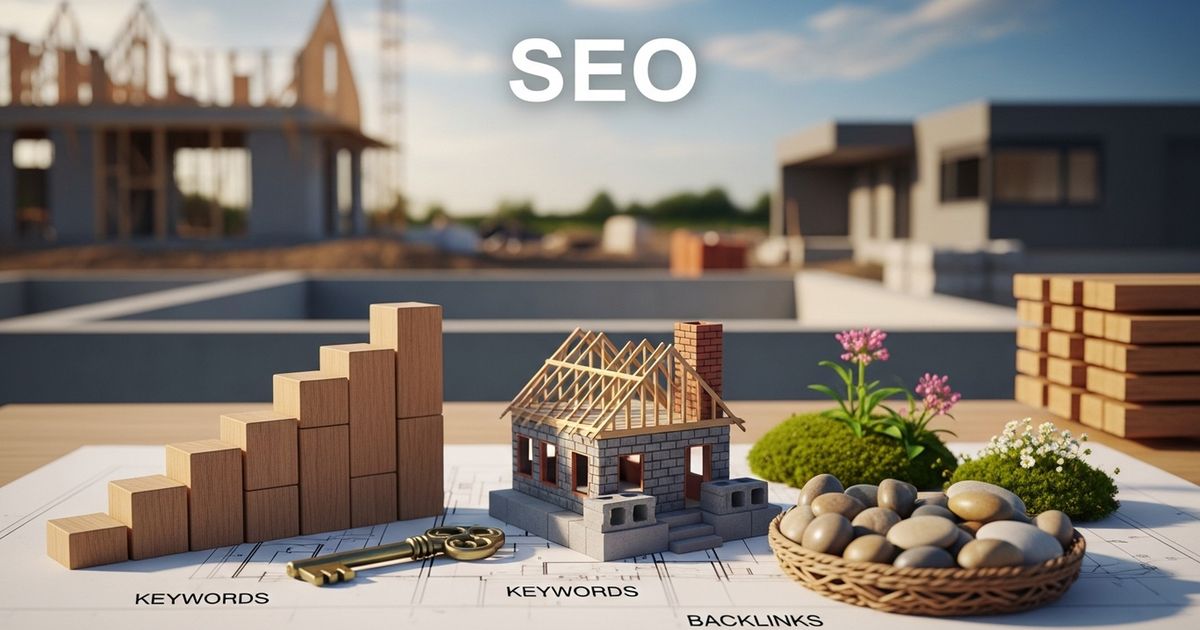
Home builders compete for high-value, local search traffic: prospects who search for "custom home builder near me" or "cost to build a 3-bed house in city" are often ready to contact a pro. This guide shows how builders and small marketing teams turn search intent into qualified leads through service-area keyword targeting, local SEO, project content, technical fixes, and a scalable content engine. Read on for specific page templates, keyword workflows, link tactics, and a 90-day plan you can act on.
TL;DR:
-
Organic content + local SEO can reduce cost per lead by 30–60% vs paid search over 6–12 months; paid search CPL for home services often falls in the $150–$600 range depending on market.
-
Build a pillar page plus 8–12 cluster pages (service pages, project case studies, neighborhood guides) and use geo-modified, long-tail keywords with clear intent mapping.
-
Automate topic clustering, article generation, internal linking, and CMS publishing to scale to 20–30 pages/month — SEOTakeoff plans start at $69/mo.
For current reference points, review HubSpot marketing blog and Content Marketing Institute.
Related guides: SEO for Landscapers: The Complete Guide, SEO for home security complete guide, SEO for interior designers complete guide, and SEO for insurance agents complete guide.
SEO for Home Builders — Quick overview and who this guide is for
This guide is for in-house content managers, small agencies, freelance SEOs, and growth marketers supporting home builders who need predictable organic lead flow. It covers local targeting, on-page templates, technical SEO for image-heavy sites, reputation management, link tactics, and how to scale content production with automation.
Key KPIs to measure:
-
Organic clicks and impressions (Google Search Console).
-
Local pack visibility and GBP (Google Business Profile) actions.
-
Contact form submissions, phone calls (use call tracking), and cost per lead (CPL).
-
Page-level conversions and time to contact.
Market context: construction spending and housing starts drive search demand for builders. The U.S. Census Bureau publishes construction and housing data that can justify content angles and seasonality for local markets; use this data when planning content that ties to regional starts or permits. Research shows mobile local searches often lead to near-term visits or contacts: Google reports a high conversion window for nearby queries, which makes local SEO a priority for builders who rely on geographically qualified leads.
Entities to include in on-site signals: Google Business Profile, Schema.org LocalBusiness markup, and industry associations such as the National Association of Home Builders (NAHB) for credibility and link opportunities.
SEO for Home Builders — Keyword research and service-area targeting
Start with a seed list of services, project types, and locations. Expand that into a keyword universe with volume and intent tags.
How to Map Keywords to the Buyer Journey
-
Informational: "how much does it cost to build a house" — use blog content and calculators to capture early-stage queries.
-
Consideration: "modern farmhouse plans" or "best custom home builders city" — use long-form comparison pages or buyer guides.
-
Transactional: "custom home builder near me" or "custom home builders city contact" — optimize service pages and GBP.
Finding Geo-modified and Long-tail Service Queries
-
Combine service modifiers with neighborhood, county, and city names (e.g., "custom home builder Lakewood, CO").
-
Add project specifics (square footage, style, materials): "3-bedroom modular home builder near Austin".
-
Use permit-related queries for local content: "building permits county" to attract research-stage prospects.
Tools and Volume/intent Checks
-
Use Google Keyword Planner for trend signals and base volume.
-
Use Ahrefs or SEMrush for competitive metrics and related long-tail phrases.
-
Pull existing queries from Google Search Console to find quick wins.
-
Use automated topic clustering (SEOTakeoff's topic clustering) to expand seeds into dozens of semantically related targets.
Keyword types comparison table
Swipe sideways to compare all columns →
| Keyword type | Typical intent | Search volume range (mid-market US city) | Recommended page type |
|---|---|---|---|
| Short (e.g., "home builder") | Broad / commercial | 500–2,000/mo | Pillar or category page |
| Long-tail (e.g., "modern farmhouse builder cost") | Consideration | 50–500/mo | Blog post / guide |
| Geo-modified (e.g., "home builder + city") | Transactional / local | 200–2,000/mo | Service page / GBP optimization |
CTR signal: top 3 organic spots capture a large share of clicks; the local pack often interrupts clicks and dominates high-intent queries. Match page content and meta to intent to improve click-throughs from both organic listings and the local pack.
SEO for Home Builders — On-page optimization for builder websites
A few page types cover most SEO needs for a builder: service pages, project/portfolio pages, and blog posts. Treat each with a clear structure and schema.
Service Pages vs Project Pages: Structure and Content
-
Service page: headline with service + location, short benefits section, scope of work, timeline estimates, pricing ranges (if possible), trust signals (certifications), clear CTA to request a quote.
-
Project/portfolio page: project overview, before/after photos, specs (sq ft, budget range, materials), permit/inspection notes, client testimonial, gallery with captions and alt text, CTA to view similar projects.
-
Blog post: problem-focused content, how-to guides, cost breakdowns, neighborhood guides, and link to pillar/service pages.
Title Tags, Headings, and Localized Copy
-
Title: include primary service and primary city (e.g., "Custom Home Builder in Raleigh | Company Name").
-
H1: clear service phrase; H2s organize details (process, FAQs, project examples).
-
Localize copy: mention neighborhoods, permit offices, typical build timelines in the region.
-
Meta descriptions: use action-oriented phrases and phone/contact cues for local intent.
Schema and Structured Data for Builders
-
Use LocalBusiness or ConstructionBusiness structured data where appropriate; reference schema.org LocalBusiness for property choices and validation.
-
Add Review schema for testimonials and aggregateRating on service pages.
-
Use Offer or Product schema for standard packages if the builder sells fixed-scope plans.
-
Validate structured data with Google's Rich Results Test.
On-page checklist and specs table
Swipe sideways to compare all columns →
| Page Type | Target intent | Ideal word count | CTAs | Recommended schema | Internal links |
|---|---|---|---|---|---|
| Service Page | Transactional / commercial | 800–1,200 words | Request quote, phone call | LocalBusiness, Offer, Review | Link to pillar, contact form |
| Project/Portfolio Page | Consideration / trust | 600–1,500 words | View similar, request consultation | ImageObject, Review, LocalBusiness | Link to related services, neighborhood guides |
| Blog Post | Informational / consideration | 800–1,500 words | Download guide, subscribe | Article, FAQ (if applicable) | Link to pillar and service pages |
Best practices
-
Use unique descriptions for each project; duplicate gallery captions across pages creates thin content.
-
Compress images and provide descriptive alt text (include neighborhoods and project types).
-
Link project pages back to the relevant service and pillar pages using natural anchor text (e.g., "custom home process").
SEO for Home Builders — Content strategy and topic clusters
Pillar Pages and Cluster Topics Tailored to Builders
-
Create a pillar like "Home Building Services in Region" that links to cluster pages: custom homes, spec homes, remodels, kitchen remodels, timeline guides, cost calculators.
-
Cluster content should target long-tail and local modifiers and funnel internal link equity to service pages.
Project Case Studies and Local Neighborhood Content
-
Write at least three project case studies with specs and client quotes early; these pages build trust and convert.
-
Publish neighborhood guides that cover zoning, typical lot sizes, permit notes, and local subcontractors — these rank for "build in neighborhood" queries.
Using Automation to Scale Content Production
-
Automation can seed topic clusters from a single idea, generate draft articles, build internal linking, and publish directly to CMS. SEOTakeoff offers topic clustering, automated article generation, internal linking, and direct CMS publishing to scale output; plans start at $69/mo.
-
Example timeline: Month 1 — publish pillar + 5 clusters + 3 project pages; Month 2 — add 10 clusters and 5 local neighborhood pages. Expected uplift: consistent publishing plus 5–10 local backlinks can lead to a 20–50% increase in impressions within 3 months and a 30% rise in organic leads over 6–9 months (results vary by market).
12 cluster article ideas
-
Cost to build a 3-bed home in city
-
Permitting checklist for new homes in state
-
Modern farmhouse vs craftsman: cost and timeline
-
How long does it take to build a custom home in city
-
Energy-efficient home upgrades that save money (use DOE data)
-
Best neighborhoods for new construction in city
-
Custom home financing options and timelines
-
Kitchen remodel cost vs full home renovation
-
How to choose a home builder: 10 questions to ask
-
Spec homes: pros and cons for buyers
-
Builder warranty and post-completion inspection checklist
-
Supplier spotlight: materials and local trades
Internal linking patterns and anchors
-
Link cluster pages back to the pillar page with natural phrases: "custom home options in region" and to the related service page with succinct anchors like the service name.
-
Avoid generic "click here" anchors; use descriptive, location-aware anchors.
This DIY video shows you the hands-on process:
For teams evaluating tooling, see SEOTakeoff’s discussion of AI SEO tools and compare manual efforts versus programmatic vs manual SEO to decide which content types to automate. When ready, integrating automated SEO publishing shortens the time from topic to live page.
SEO for Home Builders — Technical SEO and site structure
Site Architecture for Service-area Relevance
-
Use a shallow hierarchy: /services/custom-home-builder/, /projects/modern-farmhouse-city/, /neighborhoods/riverbend/. This keeps click depth low for important pages.
-
For multi-location builders, create location pages with unique neighborhood content; avoid near-duplicate templates that only swap city names.
-
Use canonical tags for pages with similar content and canonicalize tag pages or filter pages that create thin copies.
Performance: Mobile Speed and Image Optimization
-
Target Core Web Vitals thresholds: Largest Contentful Paint (LCP) < 2.5s, Cumulative Layout Shift (CLS) < 0.1, and First Input Delay (FID) or Interaction to Next Paint under recommended limits.
-
Use responsive images (srcset), WebP compression, and lazy-loading for galleries. For heavy photography, consider server-side techniques: CDN, image caching, and preloading critical images.
-
Validate structured data and XML sitemaps for projects and blogs to ensure discoverability.
Common technical checks
-
Verify mobile-first rendering and test with Lighthouse and PageSpeed Insights.
-
Ensure project pages are not inadvertently blocked in robots.txt.
-
Create XML sitemaps that include project and neighborhood pages; submit to Google Search Console.
-
Use hreflang only when offering translations; otherwise avoid unnecessary complexity.
Automation reduces human error in metadata and internal linking; automating publication through a platform that pushes structured metadata and internal links to your CMS prevents tag mismatches and missed schema on high-value pages.
SEO for Home Builders — Local SEO, directories, and reputation
Optimizing Google Business Profile and Local Pack Tactics
-
Claim and verify your Google Business Profile. Choose precise categories (e.g., "Home Builder", "General Contractor") and set service areas.
-
Upload photos: exterior, model homes, progress shots, team photos, and permit images where allowed. High-quality photos increase GBP engagement.
-
Use consistent NAP (name, address, phone) and embed a map on contact pages.
For official guidance on managing GBP settings and features, follow the steps in Google’s help docs: Google business profile help.
Citations, Local Directories, and Consistency
-
Maintain consistent NAP across local directories, trade sites, and chambers of commerce.
-
List on trade directories like Houzz and HomeAdvisor to build category relevance and referral traffic.
-
For regulatory or permitting references in neighborhood content, cite the U.S. Department of Housing and Urban Development as a trusted resource when it fits the content angle: U.S. Department of Housing and Urban Development resources.
Generating and Leveraging Project Reviews
-
Use a post-job SMS/email workflow with a direct review link to increase GBP review rates.
-
Mark up reviews with Review schema on project and testimonial pages.
-
Monitor review count and average rating; higher ratings improve local pack CTR and click-through behavior.
Example review request outline (email/SMS)
-
Thank the client for the job.
-
Ask for a short review and include a single, direct link to your GBP review form.
-
Offer a quick template clients can use (one or two sentences).
Local citations and .gov/.edu references in neighborhood or permit posts increase authority. Use HUD and local county sites for accurate permitting steps and timelines.
SEO for Home Builders — Link building, partnerships, and PR tactics
Local Partnerships and Supplier Link Opportunities
-
Get listed on NAHB or local chapter pages for authoritative local links and trust signals; NAHB membership pages are valuable local industry links: National Association of Home Builders resources and directories.
-
Ask major suppliers or subcontractors to link back to project case studies that feature their products.
-
Join local chamber of commerce and neighborhood association web pages.
Content PR: Case Studies, Awards, and Data-driven Assets
-
Create sharable assets: regional cost studies, energy-efficiency checklists, or a "cost-to-build" interactive calculator that local press will reference. The Department of Energy offers helpful data for energy content: Department of Energy guidance on efficient home building.
-
Pitch local newspapers and trade publications with press releases about notable projects, awards, or community contributions.
Scalable link goals and outreach
-
Aim for 5–10 high-quality local backlinks within six months (trade associations, local news, supplier features).
-
Use targeted outreach templates: personalize subject line with project name, mention partner benefit, and suggest exact link placement.
Avoiding Bad Link Practices
-
Avoid paid link networks and low-quality directory farms.
-
Monitor backlinks in Search Console and with Ahrefs/SEMrush to disavow spammy domains when necessary.
SEO for Home Builders — Measurement, reporting, and scaling with automation
Core Dashboards and Which Metrics to Track
-
Organic Performance: clicks, impressions, CTR, and position (Google Search Console).
-
Conversion Metrics: contact form submissions, booked consultations, phone calls (use call tracking), and cost per lead.
-
Local Metrics: GBP views, searches, and actions.
-
Page Health: Core Web Vitals, indexation status, and structured data errors.
Testing Content Variants and Conversion Optimization
-
A/B test title tags and meta descriptions for pages with high impressions but low CTR.
-
Test hero CTAs (phone vs form) on service pages and measure lead quality.
-
Use heatmaps and session recordings to identify friction on project pages.
Scaling Content Production with Automation
-
Automate cluster generation and CMS publishing to maintain cadence and consistent metadata; this reduces time between idea and live page and lowers human error.
-
Run monthly site audits to catch regressions, broken internal links, or schema issues.
For teams building a repeatable editorial process, see the recommended publishing workflow and background on what AI SEO is to align automation with quality standards.
Sample KPI targets for SMB builders
-
30% increase in organic leads within 6–9 months with a consistent publishing and linking plan.
-
Achieve top-3 local pack presence for 3–5 high-intent service/location queries within 6 months when GBP and local citations are optimized.
SEO for Home Builders — Quick checklist and key points
Quick wins (can complete in 1–2 weeks)
-
Claim and verify Google Business Profile.
-
Add three project case studies with unique descriptions and photos.
-
Fix top 5 Core Web Vitals issues (LCP, CLS).
-
Add LocalBusiness schema to the home and service pages and validate.
-
Configure call tracking to measure phone leads.
-
Update title tags to include service + primary city.
Short-term priorities (1–3 months)
-
Publish a pillar page and five cluster articles targeting core service + local modifiers.
-
Create neighborhood guides for top service areas.
-
Set up XML sitemaps for projects and submit to Search Console.
-
Request reviews via SMS/email workflow for recent clients.
-
Secure listings on local chamber and trade directories.
Longer-term priorities (3–9 months)
-
Build 5–10 high-quality local backlinks (NAHB, suppliers, local press).
-
Run A/B tests on meta titles and hero CTAs for top pages.
-
Scale to 20+ interlinked pages per month using automated topic generation + review process.
-
Maintain a monthly site audit and backlog of technical fixes.
Copy/paste checklist (12–18 items)
-
Claim GBP and set service area
-
Add LocalBusiness schema to home page
-
Publish pillar + 5 clusters
-
Create 3 project case studies
-
Compress and ALT-tag all gallery images
-
Set up call tracking and form conversion goals
-
Submit XML sitemaps to Search Console
-
Fix top Core Web Vitals issues
-
Request client reviews after project completion
-
List on NAHB and local chamber sites
-
Pitch one project to local press or trade site
-
Automate content generation and CMS publishing pipeline
The Bottom Line — SEO for Home Builders: What to prioritize first
Prioritize local presence and content that matches buyer intent: claim your Google Business Profile, publish one pillar page plus five cluster pages, and add three project pages with schema and high-quality photos. Run a basic site audit and fix Core Web Vitals to protect rankings. Consider automating topic clustering and CMS publishing to scale content output reliably — SEOTakeoff plans start at $69/mo.
90-day action plan
-
Week 1–2: Claim GBP, set up call tracking, fix top site speed issues.
-
Week 3–6: Publish pillar + 5 clusters and 3 project pages; add schema.
-
Week 7–12: Begin outreach for 5 local backlinks, request reviews, and automate editorial workflow.
How long before SEO drives leads for home builders?
SEO timelines vary: expect early improvements in visibility within 8–12 weeks for low-competition, long-tail topics and stronger lead growth in 6–9 months after consistent content and local link-building. High-competition markets may take 9–12 months to see steady organic lead volume.
Should builders target nearby cities or one primary market?
Start with a primary market where you can reliably serve clients; add nearby cities with unique, localized pages only when you can offer distinct content (neighborhood insights, permits, local suppliers). Avoid thin, duplicate location pages that only swap the city name.
Are project galleries good for SEO?
Yes. Project galleries with descriptive captions, alt text, and unique project write-ups improve relevance and user engagement. Compress images, use responsive formats, and include project specs and client testimonials to boost trust and search visibility.
Can ai-generated content be used for builder blogs?
AI-generated drafts can speed production, but quality control is essential. Edit for local detail, unique project facts, and E-E-A-T signals (experience, expertise, authoritativeness). For more on viability and best practices, read our article on AI content ranking.
What schema should a home builder use?
Use LocalBusiness or ConstructionBusiness properties where possible, add Review and aggregateRating for testimonials, and use Offer/Product schema for fixed-price packages. Validate structured data with Google's Rich Results Test and consult schema.org for property details: Localbusiness.