The best AI SEO tools in 2026 depend on the job: Profound for AI-search visibility, Semrush and Ahrefs for research, Surfer, Frase and Clearscope for content optimization, MarketMuse for topical planning, and Alli AI for technical automation. This roundup covers ten established products and what each is built to do, so you can match a tool to your workflow instead of buying the longest feature list.
TL;DR:
-
No single tool covers research, writing, optimization, linking and publishing equally well, so most teams combine two or three.
-
Profound focuses on AI-search visibility, while Semrush, Ahrefs and SE Ranking cover classic keyword, competitor and rank-tracking work.
-
Surfer, Frase, Clearscope and MarketMuse sit on the content side, from briefs to topical planning.
-
Jasper is a marketing-copy tool, and Alli AI is aimed at technical SEO automation.
Methodology
This list was built from web research on products that show up repeatedly in 2026 AI SEO roundups and that have verified vendor sites. Each tool is described only by the specialties its vendor and research profile support. No hands-on testing is claimed, and no prices or ratings are listed because none could be attributed reliably.
Selection Criteria
Three questions drove the picks:
-
Does the tool do something AI-specific, such as generative-search visibility, AI-assisted writing or topic clustering?
-
Does it support a content workflow, like briefs, scoring and editorial review?
-
Does it automate work that otherwise eats time, such as internal linking or bulk page changes?
What We Measured
Rather than scoring features numerically, the comparison looks at where each tool sits in the workflow: discovery, planning, drafting, optimization, or technical execution. That's the useful lens, because overlap is real and gaps are too. Google's own guidance on optimizing for generative AI features in Search is a good baseline for what any of these tools should support: useful content and sound technical SEO come first.
Core Criteria
Small teams and founders need output, not dashboards. So the criteria weighted toward AI-specific capability, keyword and topical planning, optimization and scoring, editorial workflow (briefs, brand voice), and automation like internal linking. What to look for in an AI SEO tool goes deeper on the product-requirements side, and the tools that actually rank piece looks at how they fit ranking workflows.
Practical Tests
Ask three things before buying: can it fix your biggest bottleneck, does it export or connect to how you publish, and will your team actually open it weekly? Results vary by site, market, baseline and publishing volume, and no tool guarantees rankings.
One honest note about the category: these tools mostly sit around the draft.
At a Glance: Top Picks
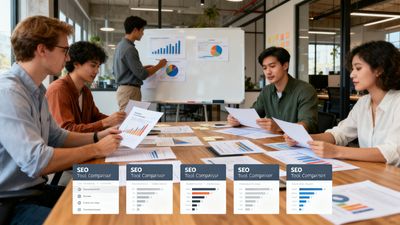
Here's how the ten tools line up. If you specifically need CMS publishing options or internal linking automation, check each vendor's documentation, since those aren't listed specialties for most of these tools. Semrush also publishes its own comparison of AI SEO tools, which is worth reading with the usual awareness that a vendor wrote it.
Comparison Table
Swipe sideways to compare all columns →
| Name | Best For |
|---|---|
| Profound | Generative-search visibility and citation tracking |
| Semrush | All-in-one SEO workflows |
| Ahrefs | Backlink and research-driven teams |
| Surfer | On-page content optimization |
| Frase | AI briefs and drafting |
| Clearscope | Editorial optimization |
| MarketMuse | Topical authority planning |
| SE ranking | Rank tracking plus content tools |
| Jasper | Brand-forward content creation |
| Alli AI | Technical SEO automation |
The decision guide near the end maps these to common team setups.
1. Profound — Best for Generative-Search Visibility
Overview
Profound is the most AI-search-native tool here. Its specialties are generative-engine optimization, AI-search visibility, prompt monitoring, citation tracking and competitor analysis. In plain terms, it's built to show how your brand appears in AI-generated answers, not just in classic blue-link results.
Pros:
-
Built around prompt monitoring and citation tracking
-
Competitor analysis within AI search
Cons:
- Specialized for AI visibility, so it isn't a general SEO suite
2. Semrush — Best for All-in-One SEO Workflows
Why Teams Use It
Semrush covers keyword research, competitor analysis, rank tracking, technical SEO and content optimization under one login. That breadth is the draw. A small team can find opportunities, check what competitors rank for, audit the site and track positions without stitching together separate products.
The trade-off with any suite is depth: specialist tools often go further in their narrow area.
3. Ahrefs — Best for Backlink and Research-Driven Teams
Strengths
Ahrefs is known for backlink research, and it pairs that with keyword research, content research, site audits and rank tracking. If your strategy leans on understanding who links to competitors and why certain pages win, this is a natural fit. Teams that treat SEO as an investigation first and a writing exercise second tend to like it.
4. Surfer — Best for On-Page Content Optimization
Content Workflows
Surfer centers on content optimization, SERP analysis, AI-assisted writing, content scoring and topical planning. You compare a draft against what currently ranks, then adjust it.
When to Use It
Use it when you already have topics and writers and want a repeatable on-page checklist.
Pros:
-
Content scoring grounded in SERP analysis
-
AI-assisted writing alongside topical planning
Cons:
- Centered on optimizing content, not on publishing or site-wide automation
5. Frase — Best for AI Briefs and Drafting
What It Does Best
Frase is built around AI content briefs, SERP research, content drafting, optimization and question research. The workflow runs from researching a query and its questions to a brief to a first draft.
Use Cases
It suits teams that lose time on brief creation. Question research helps shape headings that match what searchers actually ask.
Pros:
-
Brief-to-draft workflow in one place
-
Question research for heading ideas
Cons:
- Drafting-oriented, so broader planning may need another tool
6. Clearscope — Best for Editorial Optimization
Editorial Focus
Clearscope offers content grading, keyword and topic recommendations, content briefs and editorial optimization, with team-based content operations in mind. Editors and writers can work against the same grade, which keeps feedback objective.
Pros:
-
Content grading with keyword and topic recommendations
-
Designed for team-based content operations
Cons:
- An optimizer for content, not an end-to-end publishing system
7. MarketMuse — Best for Topical Authority Planning
Topical Planning
MarketMuse focuses on topical-authority planning, content-gap analysis, topic clusters and content inventories, plus strategic content optimization. It's the planning-heavy option: what should we cover, what's missing, and what already exists on the site.
That order of questions matters. Many teams start writing before they know what they already have, and end up with overlapping posts that compete with each other. An inventory-first approach surfaces those overlaps and shows where a cluster has holes. Topic clusters also fit how Google describes useful content: pages that cover a subject thoroughly and connect logically, rather than isolated articles.
The trade-off is that planning tools produce plans, not published pages. You still need a writing and publishing workflow behind it, whether that's a human team or software.
Ideal Users
Teams with a sizable existing library, or those mapping a cluster strategy before writing, get the most from it.
It's a weaker fit for a brand-new site with a handful of posts. With little content to inventory, the planning layer has less to analyze, and a lighter keyword and clustering workflow is usually enough to get moving.
8. SE Ranking — Best for Rank Tracking Plus Content Tools
Features Overview
SE ranking combines rank tracking, keyword research, site audits, competitor analysis and content optimization. It's a practical middle ground for teams who want monitoring and research together without the breadth of a larger suite.
The appeal is consolidation. Instead of one tool for tracking positions, another for audits and a third for competitor checks, a small team can keep the core loop in one place: research a keyword, publish, then watch whether the page moves. That feedback loop is what tells you which topics deserve more content.
Be realistic about the middle-ground label, though. It means fewer specialized depths than the biggest suites, such as Semrush or Ahrefs. If your work leans heavily on one area, like backlink research, compare it against a specialist before committing.
9. Jasper — Best for Brand-Forward Content Creation
Marketing Content Use Cases
Jasper is a marketing-content tool. Its listed strengths are AI content creation, brand-voice controls, campaign content, blog and landing-page drafting, and repurposing. A single piece can become social posts, email copy and ad variations.
When Not to Use It
If you need keyword discovery or SERP-driven optimization, pair it with a research tool.
Pros:
-
Brand-voice controls for consistent copy
-
Content repurposing across formats
Cons:
- Marketing-copy-first, so SEO research sits elsewhere
10. Alli AI — Best for Technical SEO Automation
Automation Use Cases
Alli AI targets technical SEO automation: on-page recommendations, bulk page changes, schema and internal linking. That's valuable on sites with many pages where manual edits don't scale.
Think of a site with hundreds of templated pages that all need the same fix, such as a missing schema pattern or weak internal links. Editing each one by hand is slow and error-prone. Bulk changes turn that into a single pass, which is where this category earns its keep. The flip side is that bulk edits deserve careful review, since one mistake can repeat across many pages.
Pros:
-
Bulk page changes across large sites
-
Covers schema and internal linking
Cons:
- Technical focus won't replace content planning tools
Pair it with a tool that decides what to write. Alli AI improves how existing pages are set up; it doesn't tell you which topics to target.
Which Tool is Right for You?
Decision Guide
Matching AI SEO tools for small businesses to your situation usually comes down to the persona below.
-
Solo founder blogging: Frase for briefs and drafts, plus Semrush or SE Ranking for keyword research.
-
Small in-house team: Clearscope or Surfer for editorial consistency, with MarketMuse if planning is the gap.
-
Agency managing clients: Semrush or Ahrefs for research and reporting, with Surfer for on-page work.
-
Technical, large-page sites: Alli AI for bulk changes, paired with Ahrefs or Semrush for audits.
-
Brand and campaign copy: Jasper, with a research tool alongside.
-
Tracking AI answers: Profound.
Team Size and Use Case Match
Newer entrants appear constantly, so keep an eye on emerging tools to watch before committing to a long contract.
This video compares the options to help you decide:
Frequently Asked Questions
How do AI SEO tools differ from AI writing tools?
AI SEO tools focus on research, optimization and visibility, while AI writing tools focus on producing text. Jasper is a writing-first example, and Semrush or Surfer lean SEO-first. See this breakdown of AI SEO vs AI writing tools for more.
Can AI SEO tools replace an agency?
Partly. Software can handle research, drafting and optimization, but strategy decisions and quality review still need a person. Results vary by site, market, baseline and publishing volume.
Do these tools publish directly to a CMS?
The listed specialties don't establish CMS publishing for these ten tools, so check each vendor's documentation.
How should small teams prioritize features?
Start with your slowest step. If it's finding topics, pick research or planning tools. If it's writing, pick briefs and drafting. If it's site-wide fixes, look at technical automation.